Discovery Request

As you know, Texas Central made some bold claims to the Surface Transportation Board. Well, we think it is time for them to put their money where their mouth is. The Board procedures allow us to conduct discovery, so we sent Texas Central questions and requests for documents. How much is a ticket going to cost? Will guns be allowed? What about flammable liquids? How much private financing do you have in place? Where did you get it from? Did you do any research to come up with your projection of 4 million passengers a year? Can we see a copy of your business model? What about your construction schedule?

Shouldn’t Texas Central be able to answer these simple questions? And shouldn’t they have to produce all documents, facts, and evidence supporting their claims?

Let’s see if they will respond to our requests, or just make up more excuses and continue to hide information.

Here are the questions and document requests we sent them:

FIRST SET OF INTERROGATORIES TO TEXAS CENTRAL RAILROAD AND INFRASTRUCTURE, INC. & TEXAS CENTRAL RAILROAD, LLC

Download / Print

FIRST REQUESTS FOR PRODUCTION OF DOCUMENTS TO TEXAS CENTRAL RAILROAD AND INFRASTRUCTURE, INC. & TEXAS CENTRAL RAILROAD, LLC

Download / Print

Lawsuit Against TCR Over Their Survey Permission Form

Now that we’ve updated you on the open records lawsuit against the AG and TxDOT, let’s turn our attention to the lawsuit filed against Texas Central over their survey permission form.

In the lawsuit filed by TAHSR member Jim Miles in Leon County, Jim asked the Court to rule that the survey permission form Texas Central is demanding landowners to sign is unlawful because it goes beyond the scope of what is allowed under Texas law. Jim is also asking the Court to rule that Texas Central doesn’t have the right to get on his private property. Here is a link to the lawsuit Jim filed:

On April 15, Texas Central responded to Jim’s lawsuit. Now they are saying that the survey permission form is … wait for it … VOLUNTARY, even though they’ve been telling hundreds of landowners that they MUST sign the form and let Texas Central on their land, or they will get sued. If it is voluntary like Texas Central is telling the Court in bold letters, then why are they suing landowners in Harris County to get on their property?

Texas Central is also telling the Court it can’t rule on Jim’s lawsuit. They claim the issue raised in Jim’s lawsuit is “moot” because they aren’t going to sue Jim “on the terms of the survey permission form.” But they are still trying to get on Jim’s land. It says so in the answer they filed with the Court.

So why is Texas Central telling the Court they aren’t going to sue landowners like Jim, when that is exactly what they are doing in Harris County? Why can’t Texas Central just be honest with Texas landowners and the Court?

Here is a link to Texas Central’s response in Jim Mile’s lawsuit:

Here are links to the lawsuits Texas Central filed in Harris County:

After Texas Central filed its answer to Jim Miles’ lawsuit in Leon County, Jim sent a proper notice to Texas Central to take the deposition of one of their representatives. Jim wants to know—under oath—why Texas Central thinks it has eminent domain authority and the right to enter his property to take a survey. Jim also wants to know if Texas Central has all of its money in place from its Japanese partners in order to finish construction of the high-speed train. Here is a link to Jim’s deposition notice:

Once again, Texas Central is refusing to send a representative, like CEO Tim Keith, to answer questions under oath. Instead, they filed another motion to “quash” the deposition. They also asked the Court for a protective order because they are afraid of giving any discovery related to the high-speed train.

Here is a link to the document Texas Central filed so that they don’t have to answer questions under oath or provide any information related to their project.

PRESS RELEASE January 12, 2016

TEXAS OFFICIALS VOW TO OPPOSE JAPANESE RAIL PROJECT

Jewett, Texas – Yesterday, thirty-three Texas officials sent a letter to The Honorable Kenichiro Sasae, Japan’s Ambassador to the United States, pledging to oppose the Dallas to Houston High-Speed Rail (“HSR”) Project proposed by Japanese rail interests. Elected and appointed officials representing the areas that will see irreversible harm to communities and property values, while having no benefit to citizens, including state legislators, county judges, county commissioners and sub-regional planning commission members, have all signed the letter.

Grimes County Judge Ben Leman said, “This letter sends a strong message that after considering all the information available, there is even more opposition to this HSR Project. Citizens clearly do not want this HSR to trample on the Texas constitutional protection of private property rights for the benefit of Japanese businesses. This Project is simply not viable in Texas, and the Japanese should look to other markets where there is local support.”

The letter reflects the overwhelming local opposition to the Project and follows a Legislative session in which the Texas Senate overwhelming supported a rider on the appropriations bill prohibiting any state support for HSR. Ultimately, the rider was removed only after the Texas Department of Transportation testified that they are not authorized to provide support for the HSR Project under current law. To date, no HSR Project has ever been completed and operated without significant public financing.

Leman went on to say, “As a County Judge whose county would be decimated by this unnecessary rail project, I will do everything within my power to protect the health, safety and welfare of our citizens.”

Texans Against High-Speed Rail represents a broad coalition of Texans who oppose the proposed HSR Project and garnered support for the letter to Ambassador Sasae. Kyle Workman, president of Texans Against High-Speed Rail, stated, “We appreciate the support of our officials in opposing this HSR project. This project is not just an issue of unwarranted use of eminent domain, but also one of eventual taxpayer subsidies that will impact all Texans. Our officials understand the full magnitude of the damage that can be done because of this, and I applaud their fortitude in standing with and for the citizens they represent on this issue.”

Please visit www.TexansAgainstHSR.com for more information about Texans Against High-Speed Rail, Inc.

Click here to view the letter to Ambassador Sasae.

###

Download / Print

Texas Central claims “free movement”

Click to enlarge. Will open in a new window. Check your pop-up settings.

Click to enlarge. Will open in a new window. Check your pop-up settings.

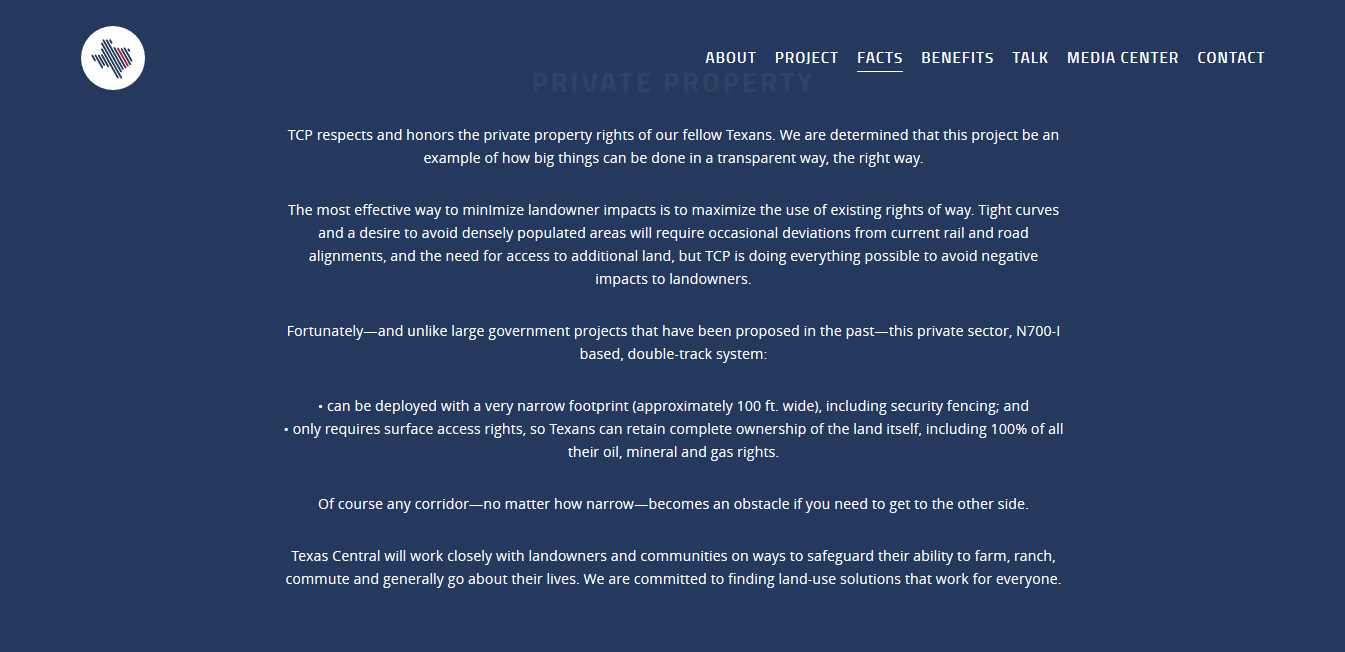
Texas Central claimed today on their Facebook page that their “engineers are designing the high-speed railway with landowners in mind by creating FREQUENT and CONVENIENT points of elevated train tracks. Free movement of people, equipment, vehicles, livestock and wildlife is one of our main priorities.” However, on their own website they refer to their tracks as an obstacle by stating, “Of course any corridor—no matter how narrow—becomes an obstacle if you need to get to the other side.”

Click to enlarge. Will open in a new window. Check your pop-up settings.

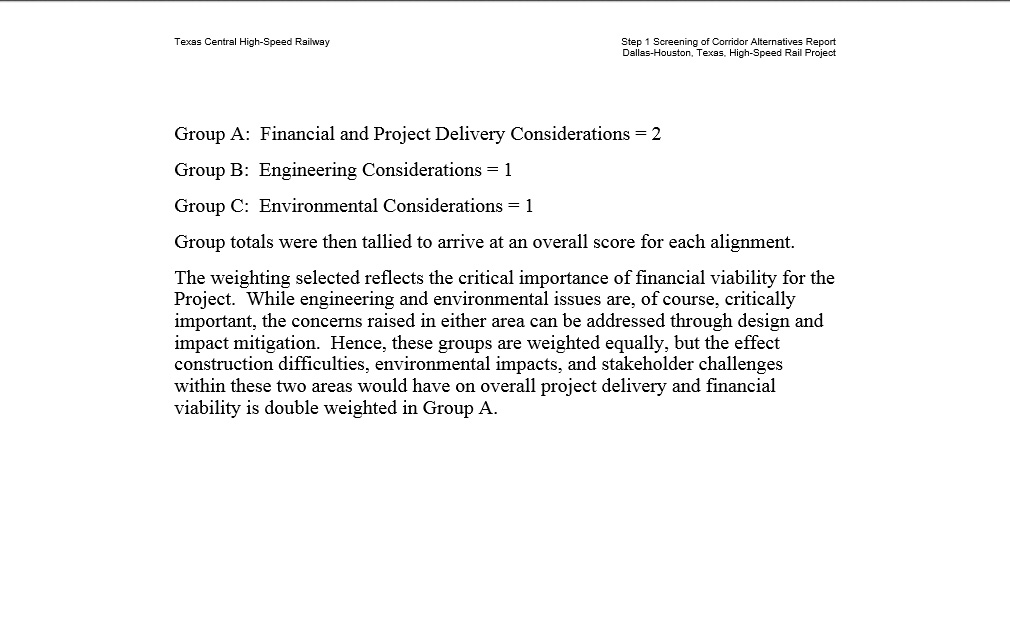
Currently, people, equipment, vehicles, livestock and wildlife move freely without any enclosed high-speed rail track impeding movement. Upon review of Texas Central’s Step 1 Screening of Corridor Alternatives Report there is no mention of free movement as one of their priorities. It is clear their priorities are financially driven. Page 22 of the report states the evaluation criteria used for weighting the corridor selection process is that financial and project delivery consideration is double weighted compared to engineering and environmental considerations.

Click to enlarge. Will open in a new window. Check your pop-up settings.

Click to enlarge. Will open in a new window. Check your pop-up settings.

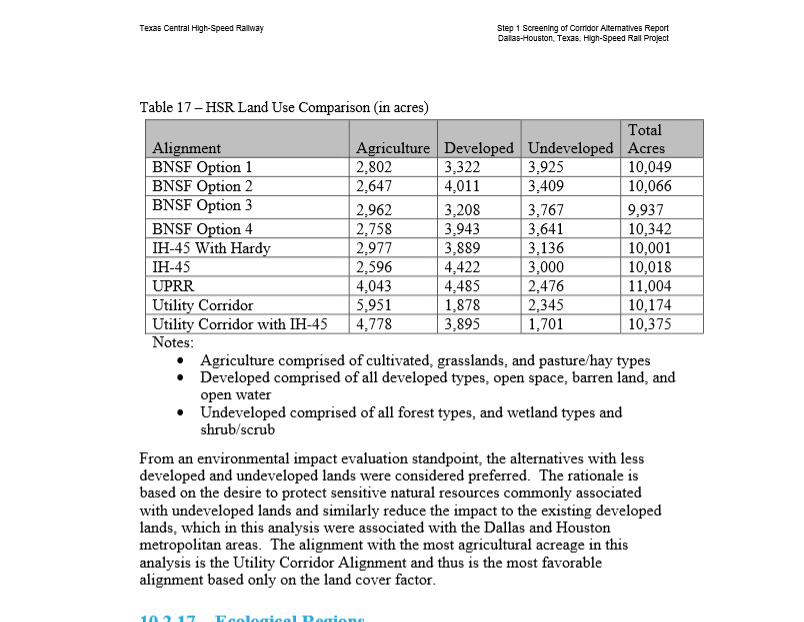
Therefore, “The weighting selected reflects the critical importance of financial viability for the Project.” Page 132 states, “From an environmental impact evaluation standpoint, the alternatives with less developed and undeveloped lands were considered preferred.” It goes on to say, “The alignment with the most agricultural acreage in this analysis is the Utility Corridor Alignment and thus is the most favorable alignment based only on the land cover factor.” Page 140 is the “Corridor Evaluation Stoplight Chart.”  While the evaluation considers many factors including financial viability, ROW acquisition, constructability issues, crossings, and prime farmland, there is no consideration for “free movement,” which is odd since they claim it to be a “priority.”

Click to enlarge. Will open in a new window. Check your pop-up settings.

Click to enlarge. Will open in a new window. Check your pop-up settings.

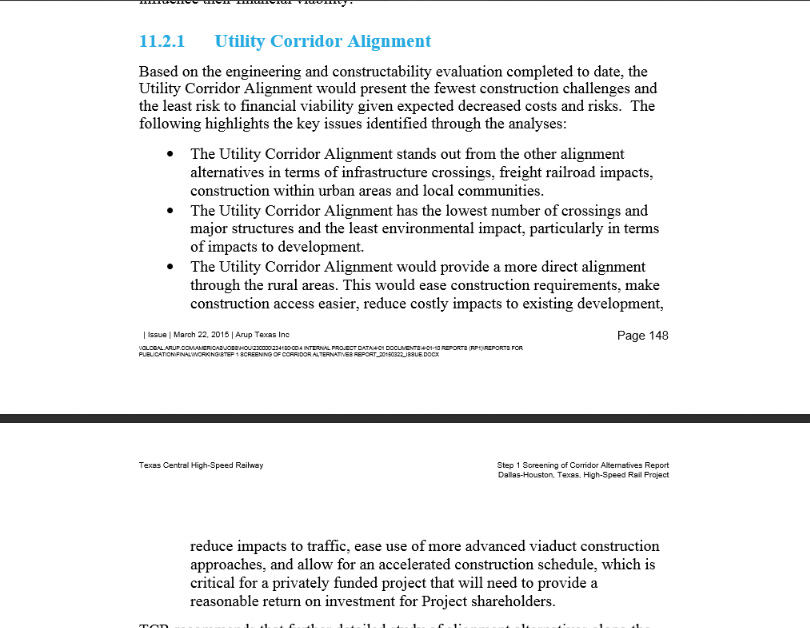
The Step 1 Screening of Corridor Alternatives Report is peppered with references to crossings of railroads, pipeline, roads and utility lines, yet no mention of crossings on private property. The true priorities are found on page 148.

  • “…the Utility Corridor Alignment would present the fewest construction challenges and the least risk of financial viability given expected decreased costs and risks.”
    • “The Utility Corridor Alignment stands out from the other alignment alternatives in terms of infrastructure crossings..”
    • “The Utility Corridor Alignment has the lowest number of crossings…”
    • “The Utility Corridor alignment would provide a more direct alignment through rural areas. This would ease construction requirements, make construction access easier, reduce costly impacts to existing development, reduce impacts to traffic, ease use of more advanced viaduct construction approaches, and allow for an accelerated construction schedule, which is critical for a privately funded project that will need to provide a reasonable return on investment for Project shareholders.”

Click to enlarge. Will open in a new window. Check your pop-up settings.

Click to enlarge. Will open in a new window. Check your pop-up settings.

The reality is that the free movement of people, livestock and wildlife is not a priority to the developers of this business venture backed by Japanese investors. Financial considerations are the bottom line and additional crossings equal increased costs.

Texas Central is not recreating the wheel. They are hoping to deploy technology already being utilized in Japan. Presumably, they know the specs and estimates of how much each crossing would cost to construct, as well as how many they could construct while still being financially feasible. But even while maintainting that they are committed to working with landowners, they have yet to provide any details on how much and how often they will provide access to landowners. The only real priority we have seen regarding landowners is when Texas Central made it a top priority to be in Austin to oppose any legislation supported by landowners, who were really making it a priority to protect their land and livelihoods. It was very clear that investor confidence was their only priority and not “working with landowners.”

So…Texas Central…landowners want to know exactly how often and how much access they will be granted after their land is taken. But, at this point, various access scenarios would at least make it seem like landowner access is even somewhere on the list.

The volunteers at TAHSR are working to make sure private property owners have unobstructed access to their properties by stopping this project.  Please help us by joining TAHSR today.

Despite Rider 48 Vote, Texas Will Not Fund HSR

As you may know, High-Speed Rail was subject to a highly unusual and highly publicized vote last night by the committee making final decisions on the state budget. After requesting that budget writers confirm that there is no current authorization for state support of high-speed rail, the committee voted 6-4 against a proposal by Senator Schwertner to place language in the budget explicitly forbidding the Texas Department of Transportation from spending any state money to facilitate the project. Senator Joan Huffman, who voted against the rider, emphasized that the vote should not be interpreted as support for the proposed HSR project, which she believes needs more study and should not begin without further evaluation from the State.

Texas Central Railway argued that Senator Schwertner’s proposed rider would kill their project as the Texas Department of Transportation has to be involved in planning and oversight; however, the last known version of the rider included language that would have allowed for TxDOT coordination and oversight. We know that no HSR project has ever existed without government subsidies, which is why we supported Senator Schwertner and his rider. However, in spite of the technical outcome of this vote, the committee sent a clear message to the Dallas Houston HSR investors and lenders, along with TxDOT, that State money will not be available for the project and included provisions, consistent with legislation supported by Texans Against High-Speed Rail, which require notice and reports to be made to local officials before a passenger rail project can begin in Texas.

Although the legislative session is coming to a close, Texans Against High-Speed Rail will continue to work with legislators as the issues related to HSR continue to be debated on transportation bills still under consideration by the Texas Legislature. We will keep you informed on how you can weigh in on those bills. Despite the rigorous pace of the legislative session and the urgency associated with our efforts, we must remain steadfast in our long term opposition plan. We thank you for the important role you have played, and will continue to play, in support of Texans Against High-Speed Rail and legislation that will protect landowners from losing their land and their heritage to an ill-conceived rail project that is not right for Texas.

You can read or listen to the discussion by the State Budget Conference Committee and the Legislative Budget Board below in the transcript or by clicking the red link for the video (NOTE: the discussions about Rider 48 begin at 5:22) …. Appropriations: Conference Committee Meeting on HB1 – May 21st, 2015.

Rider 48, High-Speed Rail Limitations
Budget Conference Committee Hearing
84th Texas Legislature
May 21, 2015

Senator Charles Schwertner –

“I’d like to make a statement, Mr. Chairman.”

Chairman John Otto –

“Sure, Senator Schwertner.”

Senator Charles Schwertner –

“Thank you Mr. Chairman. Members, this rider is about protecting the taxpayers, citizens, and property owners here in Texas. This rider is not put forth to the Senate Finance Committee in the dead of the night or through a backdoor maneuver, as I’ve read in the press. This was openly discussed in a unanimous decision coming out of the Senate Finance Committee in, subsequently, a 30 to 1 vote on the floor of the Senate. Simply put, this proposal of a high-speed rail in Texas has been sold to the people of Texas, and the taxpayers of Texas, and to members of this legislature that it will never require state taxpayer dollars to help with it’s operation or upkeep or construction. And I believe when a private enterprise promotes that promise, it should be held to account. And this rider does that. Simply put, it says that no state taxpayer dollars will be utilized in the construction of high-speed rail. It’s very simple. And it corresponds, of course, with the promise that has been made by private enterprise. However, I believe when you look across the countries and actually the entire world, there has never been a high-speed rail that has not received subsidization by the state or the government. So, I believe we’re being sold a potential bill of goods. Um, and I believe in the long-term that the citizens and the taxpayers are going to be left holding the hook … and that’s already occurred actually. The federal government, with the proposals for the building of this high-speed rail, have already put forth a TIFIA Loan, which is a $5 Billion federal infrastructure loan, which is subordinated debt, which means it comes … the repayment of that debt comes after repayment of the other aspects … other obligations of that enterprise. So, I, again, believe that we need to as a legislature, take a strong stand that the state of Texas, when told that they are not going to need state taxpayer dollars … hold them to account. And that’s all this rider did. So with that, I appreciate the opportunity, at least, to state my point of view regarding this rider. Um, and my attempt to try to, again, protect the taxpayers and property owners here in the State of Texas.”

Chairman John Otto –

“Senator Kolkhorst.”

Senator Lois Kolkhorst –

“Thank you Mr. Chairman. For clarification in moving the Senate that means that there will be no rider that speaks to the high-speed rail project, is that correct?”

Chairman John Otto –

“This is a motion to adopt the Conference Committee recommendation which is House, which would be … there would be no rider.”

Senator Lois Kolkhorst –

“That’s correct. And I just want to reiterate what Senator Schwertner said about the rider being discussed in the Senate. I had a bill, Senate Bill 1601, as well, that would have taken eminent domain authority away from this private company, and in those discussions that passed out of the transportation committee, it was said several times that this was a project that would not utilize any taxpayer dollars. And I think that the spirit of the rider in the Senate reflects what they had stated numerous times publicly. And so I appreciate you allowing us to sever this to represent our districts, whose land will be greatly affected by this, and I agree with Senator Schwertner that this could potentially have grave consequences for the State of Texas. Thank you.”

Chairman John Otto –

“Ok. Senator Huffman.”

Senator Joan Huffman –

“Thank you, Mr. Chairman and members. I’d like to support my fellow Senators here and say that, and to speak up for Senator Schwertner, to say that this was not done in the dead of night. It was discussed in the Senate. Also I’d like to state publicly that I am going to vote yes and concur with the House to ensure that the process moves along. I hope that agreeing to look at this further does not mean or is misinterpreted as being in support necessarily of the project. So, I think that’s an important message to be heard. It’s something that will be discussed, and researched, and looked at, and that’s simply what these votes mean. I just wanted to state that. Thank you very much.”

Chairman John Otto –

“Senator Kolkhorst.”

Senator Louis Kolkhorst –

“Mr. Chairman, one more follow up for you and Chair Nelson is that there is no money appropriated in this money for the high-speed rail, am I correct on that Chairs?”

Chairman John Otto –

“My understanding is that not only is there no money appropriated for this, they don’t currently have the authority to do this under … uh, the way that the way that the Fund 6 is set up. It would only be if there was whatever discretionary money might be there. And my understanding is that’s all spoke … that’s all appropriated.”

Chairman John Otto –

“Chair Nelson.”

Senator Jane Nelson –

“Mr. Chairman, that is my understanding as well, but I would like to ask the Legislative Budget Board to verify that if that’s possible.”

Legislative Budget Board –

“That is correct. There is no money in this budget for high-speed rail projects.”

Senator Jane Nelson –

“Thank you.”

Chairman John Otto –

“Senator Schwertner.”

Senator Charles Schwertner –

“Yes, but I’d like to also… thank you, Mr. Chairman. The Mobility Fund does a lot of expenditure, although it’s oversubscribed to projects such as high-speed rail, is it not?”

Legislative Budget Board –

“Yes, that is correct, but you are also correct about it being oversubscribed.”

Senator Charles Schwertner –

“Alright. So, again, this message is out to the taxpayers and property owners that this project is being sold to the people of Texas as something that will never require state backing or subsidization or bailing out, and unfortunately I think that is a complete fallacy, and one that we will rue the day that we do not stop it up front. Thank you, Mr. Chairman.”

Senator Lois Kolkhorst –

“Thank you. Mr. Chairman.”

Chairman John Otto –

“Members, we are now going to take the vote as … let me just go back over it … if you vote … this is a motion to adopt the Conference Committee Work Group Recommendation to adopt House. So a no vote means you do not wish to adopt the Conference Committee Recommendation of House … a yes vote means you do want to adopt the Conference Committee of House. If there are no further questions, Representative Gonzales moves the adoption of the Work Group Recommendation for this severed item. Are there any objections? If not, clerk will call the roll.”

Clerk –

“Chair Otto”

Representative John Otto –

“No.”

Clerk –

“Chair Nelson”

Senator Jane Nelson –

“Yes.”

Clerk –

“Turner”

Representative Sylvester Turner –

“Yes.”

Clerk –

“Davis”

Representative Sarah Davis –

“Yes.”

Clerk –

“Gonzales”

Representative Larry Gonzales – 

“Yes.”

Clerk –

“Ashby”

Representative Trent Ashby –

“No.”

Clerk –

“Hinojosa”

Senator Chuy Hinojosa –

“Aye.”

Clerk –

“Huffman”

Senator Joan Huffman –

“Yes.”

Clerk –

“Schwertner”

Senator Charles Schwertner –

“No.”

Clerk –

“Kolkhorst”

Senator Lois Kolkhorst –

“No.”

Chairman John Otto –

“There being 6 Aye’s and 4 Nay’s, the motion is adopted.”