
ABOUT US
Texans Against High Speed Rail, Inc. is a 501c(4) organization dedicated to the opposition of high-speed rail in the State of Texas.
Mission Statement
Our aim is to protect private property rights, maintain efficient modes of transportation, and prevent the wasteful use of taxpayer dollars or public subsidies for high-speed rail transportation. Our members include citizens, private property owners, business owners and elected officials from all across Texas who share our core belief of combating eminent domain for private use and our opposition to any tax-subsidized railway.
Goals
- Stop the progress of high-speed rail in Texas, including the proposed Texas Central Railway
- Protect the rights of private property owners in Texas by promoting restrictions on private use of eminent domain
- Change the culture of TxDOT to abandon high-speed rail in Texas
- Protect taxpayers from the inevitable financial disaster resulting from failed HSR projects
Activities
- Keep the public informed regarding high-speed rail in Texas, including opposition efforts
- Hold elected officials and agencies accountable
- Promote TxDOT and HSR project transparency
- Actively lobby state and federal legislators
- Advocate for the rights of private citizens

Who We Are
We are a 501c(4) organization formed in early 2015 as a coordinated state-wide effort to protect property, property rights and values, and our way of life from the negative impacts of high-speed rail, as well as prevent the wasteful use of taxpayer dollars or public subsidies for high-speed rail transportation.
As individual Texans, we may not feel that we have the means or reach to coordinate a state-wide grassroots effort, engage lobbyists or attorneys, or push back against a $20 billion project, but by being a part of a unified group, Texans Against High-Speed Rail, you can help stop high-speed rail in Texas.
The volunteer staff of Texans Against High-Speed Rail are all impacted by this current high-speed rail project, so you can be assured that we have only altruistic motivation to help preserve our property AND yours, as well as protect us all from the effects of inevitable tax subsidies.
Our supporters include residents, private property owners, business owners and elected officials from all across Texas who share our core belief of combating eminent domain for private use and our opposition to any tax-subsidized passenger railway.
Your opposition phone calls, letters and emails are an important element in opposing this current high-speed rail project, but we also need your financial support to operate a coordinated, state-wide opposition plan. Please consider donating today to help the fight.
Together we are stronger, louder and can do more to make sure our way of life is protected.
Board of Directors
Our Board of Directors is composed of dedicated individuals who share a deep commitment to protecting property rights and opposing wasteful spending on high-speed rail in Texas. With diverse backgrounds in business, law, and public policy, they provide strategic leadership to guide our state-wide efforts. Their expertise and passion ensure that Texans Against High-Speed Rail remains a strong, unified voice in the fight to preserve our way of life.

Kyle Workman
Chairman
Kyle Workman, a Leon County resident, serves as the Leon County Precinct 3 Commissioner in addition to operating multiple businesses. In addition, Kyle serves on the Board of Directors of the Texas Homeschool Coalition.
After serving as the President of TAHSR for many years, Kyle now leads the Board as Chairman, maintaining his commitment to protect private property rights and tax dollars.

Frank Reilly
Treasurer & General Counsel
Frank Reilly is a partner with Potts & Reilly, LLP and has practiced constitutional, administrative, land use, municipal, governmental, special district, legislative, ethics, business, campaign and election law for over twenty-four years.
Prior to becoming licensed as a lawyer, Frank earned seven years of experience as a legislative aide at the Texas House of Representatives; this combined with his legal practice gives him over thirty years of experience with matters pertaining to Texas law and politics. He holds an AV peer reviewed rating from Martindale Hubbell, which is the highest rating a lawyer can earn in legal abilities and ethics.
Frank was elected three times to serve as Mayor of the City of Granite Shoals, Texas, a home rule municipality with approximately 5,000 residents. He also served as the acting staff attorney for the Trinity River Authority of Texas for over a year. Noted as an “expert in Texas takings laws” by the Wall Street Journal in 1999, Mr. Reilly also has a keen interest in property rights, environmental and natural resource issues, and water law.
Frank was involved in the drafting and passage of the state’s Private Real Property Preservation Act, which gave Texas property owners a new tool to preserve their rights. He has handled cases from the simplest traffic violations to complex constitutional arguments before the state’s and nation’s highest courts. He has represented clients in various municipal courts, county courts, probate courts, the State Office of Administrative Hearings, Texas and United States District Courts, Texas and United States Courts of Appeal, and before the Texas and United States Supreme Courts.
Blake Beckham
Board Member & Special Litigation Counsel
Blake Beckham, as a fourth generation Texan, comes from a long line of land-owning entrepreneurs. He has long been a champion of private property rights and this has been evidenced in the fierce legal fight he has mounted against the proposed Dallas Houston HSR.
Texans Against HSR elected Blake to the Board of Directors in 2017 and he also serves as Special Litigation Counsel.
Blake has traveled to Austin and Washington, DC, participated in media interviews and presentations across Texas to bring more awareness of why the Dallas Houston HSR is bad for Texans and bad for Texas.
Blake is a graduate of St. Mark’s School of Texas in Dallas and Baylor University and after passing the Certified Public Accountant exam, he returned to Baylor, earning a Juris Doctorate in 1986.
Blake is an active member at Watermark Church, and in past church relationships, Beckham has served in several capacities including Sunday School teacher, committee member, and legal counsel. He currently serves as legal counsel to the non-profit charitable W. A. Criswell Foundation.
Joe Fauth, III
Board Member
Joe Fauth, a native Texan and Grimes County resident, is a management consultant specializing in organizational learning and people development. He has facilitated workshops and trainings in over thirty-five countries and taught labor negotiations and human resource management at the college level.
After twenty-five years in industry, Joe started his own management development and consulting practice, Fauth & Associates International, Inc.
In the past, Joe was involved in Little League Baseball, Boy Scouts, United Way, Community Associations, Junior Achievement and the YMCA. Currently, he is actively involved with his church, is also a lifetime member and life time committeeman of the Houston Livestock Show and Rodeo, where he serves on the Speakers Committee.
Joe is a Charter Member of the Cowboy Heritage Association, serves as a board member of the N.I.S.D. Education Foundation and other community boards at this time. Joe joined the Texans Against HSR Board of Directors in 2017 and has committed time in both Austin and Washington, DC, to represent the concerns regarding the Dallas Houston HSR.
Joe is an Eagle Scout and served in the United States Air Force and the 147th Fighter Group of the Texas Air National Guard.

Carbett "Trey" Duhon, III
Board Member
Trey Duhon was raised in Fort Bend County, Texas and has resided in Waller County since 2005. He was admitted to State Bar of Texas in 1995 and also admitted to practice in U.S. Court of Appeals, 5th Circuit; U.S. District Court, Southern District of Texas. Trey was elected to the Board of Directors of Texans Against HSR in 2018.
Trey has demonstrated his strong opposition to the Dallas Houston HSR project from the earliest public announcements and has worked tirelessly to protect the citizens of Texas from this ill-fated project.
He served as the president of the Waller County Sub-Regional Planning Commission from 2012-2018, where his work including fighting for proper coordination with regulatory bodies involved in the Dallas Houston HSR. Additionally, he has traveled to Austin and Washington, DC, to testify on proposed bills and bring the concerns of citizens directly to state and federal officials.
Trey is a 1992 graduate of Texas A&M University and received his JD in 1995 from the University of Houston Law Center.

Clark Osborne
Board Member
Clark Osborne is a lifelong, fifth generation Madison County resident. He was the 1979 Valedictorian of the Madisonville High School and a 1985 graduate of Texas A&M University, with a Bachelor’s degree in Computer Science and a minor in Petroleum Engineering.
As a father of two sons, Clark has served on the Board of Trustees for the Madisonville Consolidated Independent School District, as well as many years coaching and sponsoring his sons’ Little League teams. He also served as a Director for the MidEast Texas Groundwater Conservation District and as the President of the Madisonville Cemetery Association. Since 2022, Clark has been the County Judge of Madison County and a Director for the Brazos Valley Council of Governments.
Clark has dedicated many years of his life to serving his community and fighting to protect the private property rights of all Texans. He believes that all Texans need to band together to protect their way of life. “This thing may not be in YOUR back yard, but it’ll wind up in your back pocket! And, if we lose our private property rights, the NEXT one just might be in YOUR back yard”!

Christie Parker
Board Member
Christie Parker, a native and lifelong resident of Harris County, has dedicated her adult life to caring and advocated for patients as a critical care nurse for the last 20 years. Mrs. Parker also serves as a process mechanical estimator for a family business and previously owned company.
Her family’s fifth generational estate, where they operate a wedding venue and she serves as venue manager, is in the path of the proposed HSR route. Mrs Parker is also involved in real estate acquisition and management of timber tracts, rentals, and environmentally sustainable projects.
She has participated in numerous legislative sessions to fight for property rights and taxpayer protections against the currently proposed high-speed rail, including testifying before Texas Legislature committees and meeting with elected officials and staff.
Mrs. Parker has also made substantial comments to the Federal Railroad Administration, Texas Council on Environmental Quality, US Army Corps of Engineers and Surface Transportation Board, along with participating in numerous public meetings to oppose the high-speed rail project.

Randy Scofield
Board Member
Randy Scofield is the President and Chief Operating Officer of KSA Industries, Inc. (“KSAI”), our affiliate, having served in this position since April 2015. Mr. Scofield served as Vice President of Corporate Development and Tax Planning at KSAI for more than five years prior to 2015.
He has extensive experience with a diverse group of businesses, including oil and gas, agriculture, automotive, insurance and professional sports. Mr. Scofield is a graduate of the University of Texas and holds a Bachelor of Business Administration and a Master of Professional Accounting, specializing in taxation.
Frequently Asked Questions
Who were the initial promoters of the project?
“Texas Central” is a group of affiliated private entities: Texas Central Railroad and Infrastructure, Texas Central Partners, Texas Central Railway, etc. Here is their website. Jack Matthews, Drayton McLane, John Kleinheinz, and other wealthy individuals from DFW and Houston put up some of the seed money to get the project started.
Although they call themselves Texas Central and promote themselves as a Texas company, the project is really backed by the Japanese government. Texas Central is partnered with the Japan Bank of International Cooperation, which appears to be Texas Central’s current primary source of funding. Texas Central is also partnered with Central Japan Railway Company (known as JR Tokai), which operates the Tokaido Shinkansen bullet train line linking Tokyo with Osaka. Texas Central is planning to use JR Tokai’s Shinkansen trainset technology for the project.
What happened to Texas Central’s leadership team and who is in charge now?
On June 12, 2022, Carlos Aguilar announced his resignation as Texas Central’s Chief Executive Officer. In a post on LinkedIn, Aguilar lamented that he “could not align our current stakeholders on a common vision for a path forward.” As reported by The Texan, Aguilar’s biography has been missing from Texas Central’s website since April and no executive team members are currently listed on the site. The Texan later updated its article to reflect that Drayton McLane is no longer Chairman of Texas Central’s Board. Other outlets have reported on Aguilar’s sudden departure, including the Houston Chronicle and Dallas Business Journal. A Spanish news site in Madrid, “La Informacion,” reported that in addition to the departure of Texas Central’s entire management team, the project has entered “a hibernation phase in search of financing.”
Following these reports, the Texas & Louisiana Engineering News-Record reported that Texas Central’s entire “board of directors was recently disbanded.” Former Chairman Richard Lawless said that Texas Central is now being managed by Michael Bui, a senior managing director at FTI Consulting who specializes in financial advisory and corporate restructurings. Mr. Bui advises clients through distress events, bankruptcy, reorganization, and sale. Another representative from FTI Consulting, Senior Managing Director Tom Becker, recently stated to the Texas Tribune that “Texas Central is continuing to seek further investment, and is moving forward with the development of this high-speed train.”
Where’s the route?
The proposed route covers approximately 240 miles from Dallas to Houston. Here are the maps showing the route through each of the 10 affected counties.
In Dallas, the proposed station location is close to the convention center, behind the Alamo Drafthouse. Texas Central has an agreement with Jack Matthews’ company, Matthews Southwest, to serve as the development partner of the Dallas high-speed rail station and surrounding areas.
In Houston, the proposed station location is by the old Northwest Mall (closed down in 2017), which is about 9 miles from the city center. As a result, once passengers arrive by high-speed rail in Houston, they’ll still be stranded much like arriving at Hobby. They’ll have to rent a car or catch an Uber to get into town.
There will be one stop between Dallas and Houston in Grimes County. They’re calling it the Brazos Valley Station and claiming it will service A&M students in College Station. However, if you look at a map, this makes no sense at all. A&M students who live in Houston are going to get in their cars and drive directly to College Station.
What about social justice? What groups will be impacted?
The project would disproportionately impact minority and low-income communities. Of the 135 total block groups studied by the FRA, 87 were identified as minority or low-income block groups. 63 of these 87 block groups (72%) are located in Dallas and Harris Counties. In Dallas County, 27 of the 30 block groups impacted by the project have minority or low-income communities (6 minority communities, 1 low-income community, and 20 identified as both).
The project would displace between 279 and 321 total residential, commercial, and community facility structures. Of those, 111 to 135 would be located within minority or low-income block groups. Homes would be displaced within each of these minority or low-income communities.
The Le May and Le Forge community, located between Illinois Avenue and Loop 12 in Dallas County, would be directly impacted by the project, as at least 14 homes would be displaced. The neighborhood is part of the larger Cedar Crest neighborhood but it is isolated by utility and freight rail infrastructure. The project would further isolate this minority and low-income neighborhood from the rest of the Cedar Crest community. Only 20 homes would remain, and a portion of Le May and Le Forge Avenues would be adjacent to the Project’s viaduct infrastructure, creating an impact to the cohesive character of the remaining part of this neighborhood.
In the Plantation Forest development located in Waller County adjacent to the CenterPoint highvoltage transmission line, the project would displace approximately 12 homes. The project would intersect the community via embankment and transition to viaduct approaching Riley Road. Community cohesion impacts would occur through displacement of residents.
Rural communities would also be disproportionately impacted. Due to the size and nature of the embankments, fencing, and speed of the project, family farms and ranches would be divided into “east” and “west” farms with endemic cross-access problems. Crops and cattle would be constricted to smaller areas, and farmers and ranchers would be unable to move farming and ranching equipment from one side to the other. This would restrict access to barns, pens, corrals, and water sources, requiring landowners to divine new places to house and water their animals.
Is the project environmentally friendly?
No, for several reasons.
First, construction of the project will cause more pollution than it prevents because building a highspeed rail line and associated berms and crossings is very energy-intensive, creating an enormous carbon footprint. University of California Berkeley research concluded it would take 71 years for the California high-speed rail project to save enough greenhouse gasses to make up for the pollution caused during construction. Building a so-called “green train” is not really green. For Texas Central’s project, it could take up to 50 years of operations (at near capacity) just to counter the carbon footprint released during the massive construction phase. Additionally, projections by the California Air Resources Board bemoaned that the California high-speed rail would only account for 1.5% of California’s goal for reducing emissions, and at a substantial cost.
Second, Texas Central’s project will derive significant amounts of power from coal burning plants that rely on strip-mined, lignite coal. Texas Central has not even attempted to quantify the natural destruction caused by the additional strip-mining that will be need to meet its electricity demand.
Third, Texas Central’s supposed environmental benefits are misleadingly as they are based on comparisons of a completely full high-speed rail line and a Boeing 777. However, the airplanes that fly between Dallas and Houston are much smaller Boeing 737’s, McDonnell Douglas MD 80 series-planes, Airbus A319 and A320 aircraft, or 50-75 seat regional jets. All of these aircraft emit significantly less carbon dioxide than a Boeing 777. Moreover, Japanese trains operate with much higher passenger loads than the average Texas Central train is projected to carry. And, importantly, Texas Central has no real possibility of running its trains anywhere near capacity, which would negate any potential environmental benefit. Texas Central has provided no data to suggest that true environmental savings will take place, while all available data strongly suggests just the opposite.
How long will the 240-mile ride take?
Around 90 minutes allegedly, but that assumes top speeds at over 200 mph and doesn’t include security screening. There will have to be TSA-level security due to terrorist and other threats. As just one example, in 2015, there was a suicide attack on a high-speed rail in Japan. The terrorist immolated himself, and smoke filled the train coach. The windows on a high-speed train can’t be opened, and the doors can only open once the train fully stops, which takes several minutes. Any fire creates an imminent risk of death by smoke inhalation. Not to be overly dramatic, the point is you won’t be able to hop on and off like it’s a bus, so the “back and forth between Dallas to Houston in just 90 minutes” is misleading, to say the least.
How much will a ticket cost?
Nobody really knows, including Texas Central. Currently, its website says the following:
Ticket prices will be based on a variable pricing model, with consumer demand driving price fluctuations. Factors like how far in advance you purchase, what day, what time of day, which discounts you are eligible for, etc., will all influence the price. Furthermore, there may be different classes of service (think first class, business class, etc.) to offer price points for all travelers – regardless of budget.
World class ridership studies have been done and continue to inform what travelers want to create a best-in-class experience.
More concisely: on the high end, tickets will be competitive with the cost of flying, and on the low end, they will be competitive with the cost of driving.
Texas Central told the Texas Department of Transportation to assume a $108 one-way ticket price in analyzing ridership numbers. Texas Central’s former CEO once said, “We’re a private company. It’s going to cost as much as we can afford to charge you and you’ll be willing to pay.”
Will the project be elevated or run on the ground?
Some of the project will be elevated on a concrete viaduct and the rest will run on a 20-foot-high earthen berm. The percentages of viaduct track versus land berm is unknown. Likewise, it is unknown which portions of the track (location-wise) will be on a viaduct or land berm. Texas Central’s website says both options “provide for large and conveniently located underpasses or overpasses.” Yet, to the public and in depositions, Texas Central has refused to commit to providing each landowner an underpass or overpass to get to the other side of their property. They won’t make that promise.
How much is the project going to cost to build?
In 2016, Texas Central claimed it would cost “over 10 billion dollars to construct.”
In 2018, Texas Central admitted costs had risen to “approximately $18 billion…”
The Federal Railroad Administration (FRA) permitting dashboard for the project estimates costs of $19 billion.
In April 2020, Texas Central Chairman Drayton McLane admitted costs have now ballooned to at least $30 billion. When asked about this new $30 billion estimate, CEO Carlos Aguilar commented it was “a conservative estimate of ‘all in’ numbers.”
Despite these admissions, Texas Central still claims on its website the project “will cost more than $12-billion to construct.”
Does Texas Central have the money to build the project?
No, not even a fraction of it.
In 2016, Texas Central admitted it had less than 1% of the financing it needs for the Project.
As of August 2019, Texas Central admitted it had raised “over $450 million dollars” in financing. This amount, which includes a $300 million loan from the Japan Bank of International Cooperation, accounts for merely 1.5% of the project’s estimated $30B+ costs.
In March 2020, Texas Central laid off 28 employees, including executive level, public relations and field staff positions within the company.
If Texas Central doesn’t have any money, who is going to pay for the project?
For years, Texas Central has claimed the project “is a private venture with private investors putting their capital at risk.” In numerous state court lawsuits, it swore to courts that it will construct the project “with exclusively private financing.” As recently as August 2019, Texas Central swore to a federal agency that the project will be “financed entirely by investors and entrepreneurs.”
In April 2020, Texas Central admitted it intends to rely on funding “from President Trump’s infrastructure stimulus through the Department of Transportation.” CEO Carlos Aguilar confirmed the project “could require some stimulus money, but we don’t know yet.”
In addition to stimulus money, Texas Central has repeatedly admitted it will “aggressively” seek Railroad Rehabilitation & Improvement Financing loans from the U.S. Department of Transportation, which are rarely repaid. This, of course, is also public money.
In short, taxpayers are going to pay for the project if Texas Central is allowed to move forward.
Is the project financially feasible?
No. Virtually all infrastructure experts who have analyzed the project agree a high-speed rail line connecting the low-density, car-friendly metro areas of Dallas and Houston could not be profitable without massive public subsidies.
Only two high-speed rail lines in the world are profitable: Paris-Lyon in France and Tokyo-Osaka in Japan. The rest require massive government subsidies.
Texas Central projects 6 million annual passengers by 2029. To be clear, this means 6 million oneway trips per year, either from Dallas to Houston or vice versa. That’s 16,438 passengers per day.
By comparison, on average 2,529 passengers flew between Dallas and Houston per day during 2017 Q1 — 2018 Q4. This is an apples-to-apples comparison (one-way trips including all airports in Dallas and Houston) based on public data from the U.S. Department of Transportation. And, this number of daily air travelers has steadily declined over the past few years, even before COVID. If Texas Central were to somehow convince every single air traveler to divert to its high-speed rail, it would still need 13,900 more passengers, each and every day, to meet its projections.
Another comparison: the heavily-trafficked Union Station in Washington, D.C., serves approximately 5 million Amtrak passengers annually. In Philadelphia, 30th Street Station transports approximately 4.3 million Amtrak passengers annually.
The Texas Department of Transportation, an agency with decades of experience analyzing massive infrastructure projects, forecasted 2035 annual ridership between 0.7-2.7 million passengers.
The Reason Foundation, a non-partisan think tank, published a study High-Speed Rail in Europe and Asia: Lessons for the United States in which one of its experts concluded that most U.S. highspeed rail lines would “lose substantial amounts of funds. Only the Northeast Corridor could potentially break even.”
In 2017, the Reason Foundation released a report on Texas Central’s project titled Texas High Speed Rail: Caution Ahead. It included both a summary and 65-page detailed analysis. After estimating annual ridership at 1.4 million passengers, Reason stated Texas Central’s ridership projection “is not grounded in reality.” This chart summarizes the Reason Foundation’s concerns:
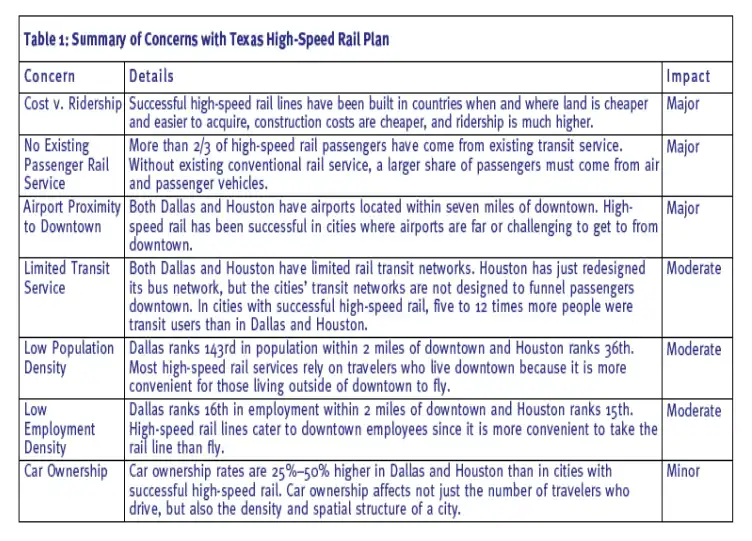
More from Reason: “Dallas and Houston are poster children for big cities where high-speed rail has no chance of succeeding without public funding unless land use and transit patterns change dramatically.” Reason concluded the project “will fail so spectacularly that privately financed U.S. high-speed rail lines may never be given a second chance.”
The Texas Department of Transportation (TxDOT), an agency with decades of experience analyzing massive infrastructure projects, also concluded Texas Central’s ridership projections are grossly inflated. TxDOT forecasted 2035 annual ridership between 0.7 – 2.7 million passengers.
John T. Harding, PhD, the former Chief Maglev Scientist of the FRA, said the Project is destined for “certain failure.” He concluded that Texas Central’s ridership projections are greatly exaggerated, to the tune of almost six times that of his projections. Using Texas Central’s own projections and cost estimates (which, at the time of his analysis, were much more conservative), Dr. Harding found that by 2035 Texas Central will run an annual loss of at least $250 million.
High-speed rail works where you have densely populated city centers on each end, full of people who don’t own cars and rely on public transit. In many instances, an existing train line will be overcrowded or outdated. The old train is replaced with a shiny new high-speed rail. When this happens, there is an existing customer base. The notion that Texas Central can just plop a highspeed rail down in Texas (where it is cheap to own a car, everybody owns one, and nobody uses public transit) and people will divert to it at the projected levels is pure fantasy.
If Texas Central has support for its ridership and job numbers, why won’t it share it purported studies with the public?
According to Texas Central, two studies support its ridership numbers. The first, prepared by The Louis Berger Group in 2013, was provided to TxDOT pursuant to a non-disclosure agreement. In response to TAHSR’s open records request for the Louis Berger study, TxDOT refused to produce it. Instead, TxDOT sought an opinion from the Texas Attorney General, who agreed TxDOT could withhold the study from disclosure. TAHSR then sued TxDOT and the Texas Attorney General in Travis County and moved for summary judgment to force disclosure of the document. Texas Central intervened in the lawsuit to protect the Louis Berger study from public disclosure. Ultimately, the court sided with Texas Central, TxDOT, and the Texas Attorney General, and allowed the Louis Berger study to be withheld from public disclosure.
As suggested by Texas Monitor’s Steve Miller, Texas Central wants the best of both worlds: “Texas Central is asking to use government powers to build its railroad, but also asserting a private company’s privilege of denying public requests for records about its project – a privilege that may become problematic for taxpayers if Texas Central wins the right to take land in an 11-county stretch through the center of Texas.”
Texas Central’s second purported ridership study was prepared by L.E.K. Consulting. According to the Reason Foundation, the L.E.K. study was “written by an anonymous author at a global management consulting firm” and “has a number of its own problems.” In any event, Texas Central has refused to disclose the L.E.K. study to the public as well.
For years, Texas Central has boasted that the project will create jobs and generate billions in tax revenue. On its website, Texas Central claims the project will “inject an estimated $36 billion in economic benefits over its first 25 years” and “create an estimated 10,000 direct jobs per year during construction and more than 1,500 direct permanent jobs when the train is fully operational.”
The source for these claims is an executive summary report created by Insight Research Corporation in October 2015 titled Texas Central’s High Speed Rail Corridor and Related Private Development Houston to Dallas/Fort Worth, Texas which summarizes Insight’s “economic impact analysis.” Yet, Texas Central refuses to disclose the full analysis to the public.
How much private property will be affected?
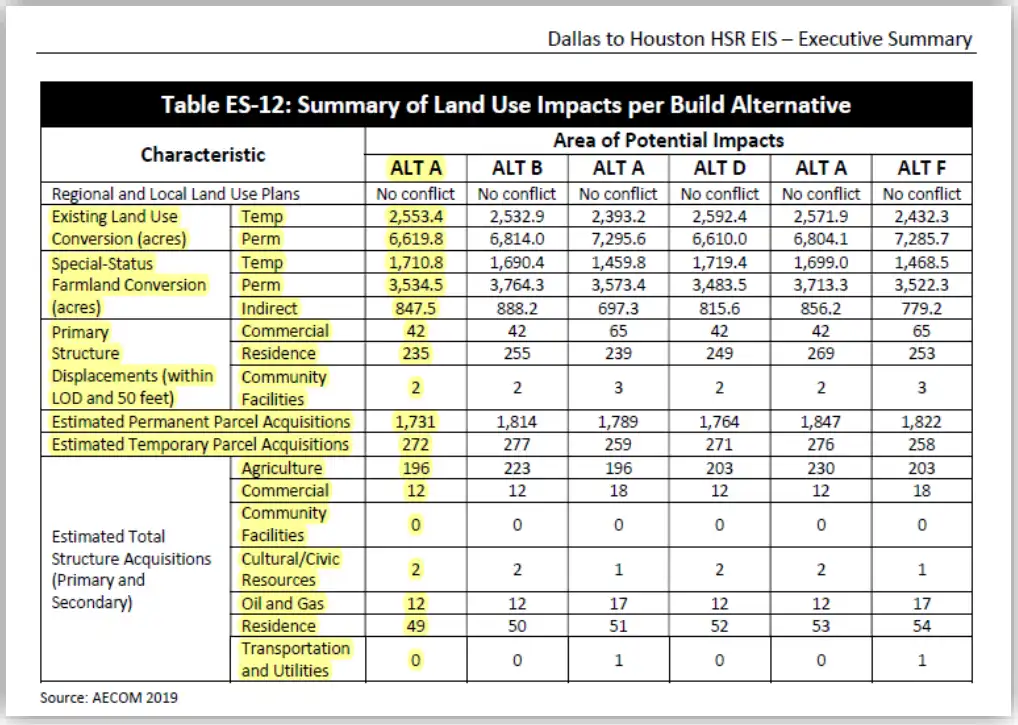
Over 15,000 acres (all new right-of-way), according to the most recent environmental impact statement released May 2020. This chart shows how much property will be impacted:
What’s the deal with the eminent domain fight and where does it stand?
There’s been protracted litigation for over four years, in more than 40 lawsuits spread all over Texas. However, the legal issue is fairly simple.
The Transportation Code has separate definitions for a “high-speed rail,” “railroad company,” and an “interurban electric railway. There is no dispute Texas Central qualifies as a “high-speed rail.” The problem however, for Texas Central, is the Texas Legislature chose not to vest high-speed rails with eminent domain authority. As a result, Texas Central claims it is a railroad and an interurban electric railway, both of which do possess full eminent domain powers. In doing so, Texas Central gave itself two bites at the eminent domain apple.
A “railroad company” is defined as a railroad incorporated before September 1, 2007 or “any other legal entity operating a railroad.” Since Texas Central incorporated in 2012, the sole issue is whether Texas Central is “operating a railroad.”
Landowners’ legal argument has been and remains simple: it is undisputed Texas Central has no trains, no tracks, no stations, and has never transported passengers or freight anywhere. Thus, based on the plain and common meaning of the terms, Texas Central is not “operating a railroad.” Rather, it is merely a promoter of a high-speed rail it hopes to operate at some point in the future.
Texas Central, on the other hand, claims it began “operating a railroad” immediately upon incorporation.
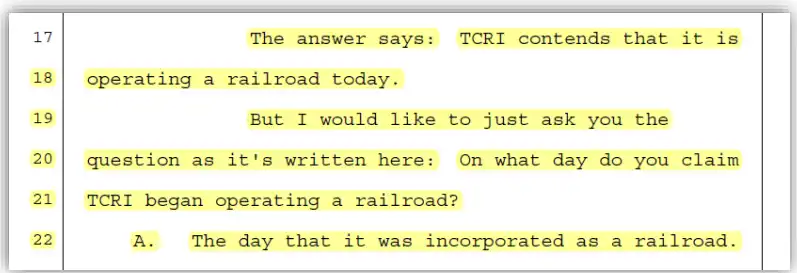
According to Texas Central, once it filled out its papers in which it self-declared to be operating a railroad, and paid the $300 filing fee, it was immediately vested with eminent domain authority.
Texas Central also claims it is “operating a railroad” because it is doing all the things a railroad company does at this stage of its existence. In other words, Texas Central argues, “look at all this money we’ve spent and activities we’ve completed, of course we’re a railroad company.”
Finally, Texas Central claims it qualifies as a “railroad company” because it “will be operating” a railroad in the future. In essence, Texas Central has made every possible, contrived argument to distract from the undisputed fact that they are not presently “operating a railroad.”
As for an “interurban electric railway,” it is defined as “a corporation chartered under the laws of this state to conduct and operate an electric railway between two municipalities in this state.” The interurban electric railway industry in Texas was in place by 1913. Interurbans operated as rail service between large cities and surrounding rural towns as an alternative to horse-drawn buggies. By 1941, only two remained; both ended service in 1948. Here are photos of interurbans:

Here is Texas Central’s bullet train, the “first high-speed passenger train in the U.S.,” which will employ “state-of-the-art Shinkansen technology” to run at speeds “approaching 200 mph”:
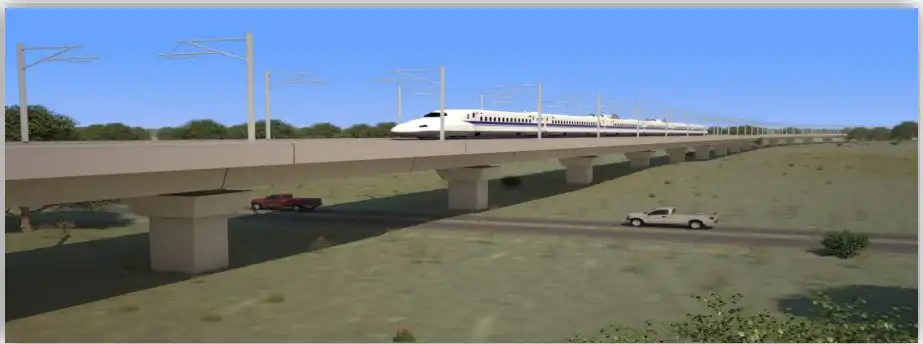
For a variety of reasons, many of which may appear obvious, landowners argue Texas Central does not qualify as an interurban, a mode of transportation that has been extinct in Texas for over 70 years. Regardless of what Texas Central’s incorporation papers say, they have no intention of constructing or operating an interurban electric railway.
At the trial court in Leon County, landowner Jim Miles prevailed. The trial court ruled that Texas Central and its newly-formed affiliate, Integrated Texas Logistics, Inc. (ITL), were not railroads or interurbans under Texas law. Texas Central appealed.
Texas Central’s appeal started in Waco but was transferred to Corpus Christi. Landowner Miles lost on appeal. The Corpus Christi panel reversed the trial court ruling, finding that both Texas Central and ITL are railroads and interurbans with eminent domain authority under Texas law.
After the court of appeals reversed, Miles petitioned the Texas Supreme Court for review. Miles filed his Petition for Review on July 31, 2020. Texas Central filed its Response on August 28. Miles filed his Reply on September 21, 2020.
On October 16, 2020, the Texas Supreme Court requested full briefing on the merits. Miles filed his Brief on the Merits on December 10, 2020. Texas Central filed its Response Brief on the Merits on December 28, 2020. Miles filed his Reply Brief on January 25, 2021.
The Texas and Southwestern Cattle Raisers Association, Texas Farm Bureau, French train company SNCF, the eight impacted counties between Dallas and Houston, and other landowners filed amicus briefs in support of Miles.
On June 18, 2021, the Texas Supreme Court denied Miles’ Petition for Review. Miles filed a Motion for Rehearing on July 29, 2021, which the Texas Supreme Court granted. Along with granting Miles’ Motion for Rehearing, the Texas Supreme Court invited the Texas Attorney General to provide an opinion as to whether he believed Texas Central and ITL have eminentdomain authority. On December 17, 2021, the Texas Attorney General sided with Miles, opining as follows:
The State takes no position on the wisdom or utility of building a high-speed train between Dallas and Houston. But private actors who seek to seize private property using eminent-domain powers must strictly comply with statutory and constitutional conditions governing the use of such powers. Respondents have not.
On January 11, 2022, the Texas Supreme Court heard oral argument on the Miles case.
On June 24, 2022, the Texas Supreme Court affirmed the court of appeals’ opinion in a 5-3 decision. Justice Lehrman wrote the majority opinion. The majority agreed with the court of appeals’ ruling that both Texas Central and Integrated Texas Logistics have eminent-domain power as interurban electric railway companies. Because the majority ruled that both Texas Central and ITL have eminent-domain power as interurbans, it said it need not address whether these entities also qualify as railroad companies.
Justices Hecht and Young wrote concurring opinions (Hecht concurrence, Young concurrence). Justices Huddle and Devine wrote dissenting opinions (Huddle dissent, Devine dissent).
Where does the State of Texas stand on the project?
Texas understands that this project is headed for a repeat of the ongoing high-speed rail disaster in California, where costs have ballooned from $33 billion to over $100 billion with no end in sight. In 2017, the Texas Legislature passed a law prohibiting the use of any State funds for private highspeed rail. That law remains in effect today.
What’s the deal with the option contracts that were deeded to the Japan HSR company in the Cayman Islands?
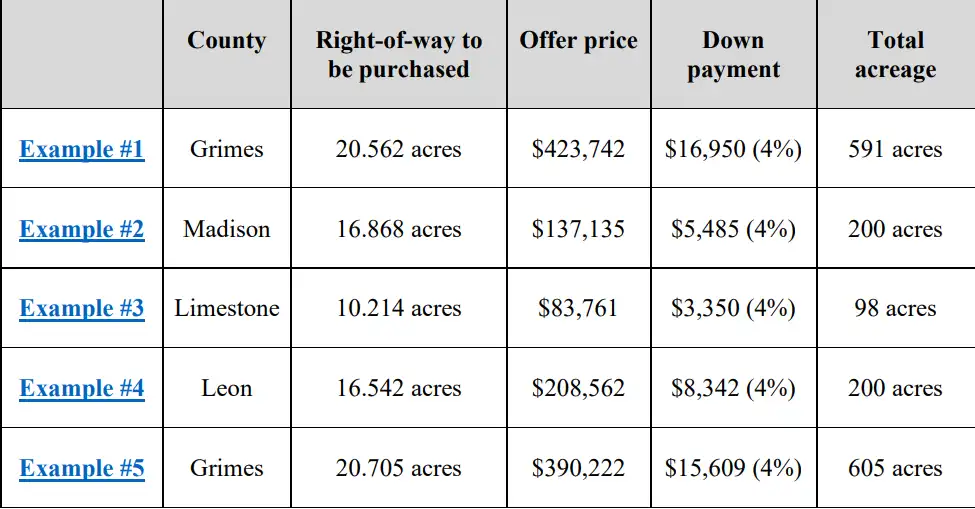
Texas Central has what it calls an Option Purchase Program. Essentially, Texas Central offered to purchase all or a portion of certain landowners’ property along the route. In exchange for a 4% down payment of the total purchase price, Texas Central would retain right to exercise its option to purchase the property until a date certain (most of the options expired on December 31, 2018 or 2019). In many instances, the property to be purchased encompassed just a sliver of the landowner’s entire property. Texas Central offered over market value for this sliver, and agreed to pay the 4% down payment shortly after execution of the option. According to many landowners,
Texas Central told them they might as well go ahead and sell since Texas Central had eminent domain and could take their property forcibly if necessary.
Although Texas Central offered over market value for the amount of property to be purchased, the purchase price did not compensate the landowner for the devaluation to the remainder of the property. In an eminent domain proceeding, the landowner would be entitled to recover compensation for this devaluation in addition to the fair market value of the property to be taken.
Below are a few examples of Texas Central’s proposed option contracts. In each example, the property would be bisected by the project, thus resulting in significant devaluation to the remainder of the property not being purchased. If these landowners would have agreed to these option proposals, Texas Central would have been able to avoid having to pay a substantial amount of money to compensate for the devaluation to the remainder.
Although Texas Central was able to pay the 4% down payments on the purchase price, it did not have the money to close. As a result, in 2018, the Japan Bank for International Cooperation, a public financial institution and export credit agency wholly owned by the Japanese government, created a special purpose vehicle, Japan Texas High-Speed Railway Cayman LP, to loan $300 million to Texas Central. At the time, Texas Central told the press it would “use the funds to move ahead on permitting, design and engineering, as well as other preliminary work needed to launch construction during 2019.” In fact, Texas Central used the money on loan from the Japanese government to close on its option contracts. To date, it has closed on more than 100 of them.
Based on a series of recently recorded real property transactions in counties along the affected route, it appears the Japanese government required Texas Central to put up the land as collateral for the sizeable loan. In each county (Leon, Waller, Madison, Harris, Grimes, Dallas, Ellis, etc.), Texas Central filed a “Deed of Trust, Assignment of Leases and Rents, Security Agreement and Fixture Filing” relating to property owned by Texas Central in that county. The beneficiary of these Deeds of Trust is an offshore entity named “Japan Texas High-Speed Railway Cayman GP (in its Capacity as General Partner of the Japan Texas High-Speed Railway Cayman LP),” and the named Trustee is Dallas-based attorney Keenan Kolendo. Texas Central did not disclose the existence of this offshore beneficiary to any of the landowners it convinced to sign an option contract. Nor did it disclose its plans to use the property purchased through the option contracts to secure a loan from the Japanese government.
The Deeds of Trust were executed by the debtor and property owner (Texas Central), to a trustee (attorney Keenan Kolendo), who will hold the property in trust for the creditor (Japan Texas HighSpeed Railway). Although the Deeds of Trust do not convey actual title to the offshore Japanese entity, the security interest can quickly and easily be converted to full legal and possessory title without judicial foreclosure if Texas Central defaults on its loan payments.
Given its ongoing and widely-reported financial struggles, Texas Central will likely default on its loan. Or, Texas Central could simply choose to intentionally default in order to put the property into the hands of its Japanese backers. In either event, upon default and foreclosure of the Deeds of Trust, the Japanese government will own all of the property subject to them. Although Texas Central claims it works “hand-in-hand with landowners” and deals “in good faith in a fair and respectful process,” it did not disclose this scheme to landowners at the negotiating table.
During the 2019 legislative session, Texans Against High-Speed Rail worked with numerous state officials to introduce bills designed to protect Texas landowners from Texas Central’s option contract scheme. For example, House Bill 1367 gave landowners who signed option contracts under the threat of eminent domain the right to get their property back from Texas Central if it was used for something other than the proposed high-speed rail project, or if the project was cancelled. Had this bill been enacted into law, landowners would now be in a position to reacquire their property if Texas Central defaults on its loan or cancels the project. As it stands, however, upon default the property will be transferred to the Japanese government to be used for some other purpose, and the landowners will have no means of getting it back.
How does Texas Central treat landowners?
Poorly. Texas Central sued more than 100 landowners in over 40 cases in 6 different counties in an attempt to find some court, somewhere, to endorse their legal arguments and grant them eminent domain authority. Texas Central has bullied landowners into selling their property through option contracts under the threat of eminent domain. They’ve pulled stunts like this. In the last legislative session, they swore to legislators they wouldn’t exercise options on property until they had all their money and permits, which was a lie. This recent article talks about other stunts they’ve pulled,including sending threatening letters to landowners on the Friday before a July 4 holiday weekend. The article also features Jim and Barbara Miles, the landowners whose eminent domain lawsuit is headed to the Texas Supreme Court.
Numerous other impacted landowners have submitted statements, including sworn declarations, regarding their interactions with Texas Central. Here are a few examples: Gene Whitesides declaration; Ron Richards declaration; Christie Parker declaration; Christie Parker trespass declaration, August Lander statement, Donovan Maretick declaration; Annitta Dobbs statement.
Does Texas Central have approval to construct the project?
No. In 2016, Texas Central sought permission from the Surface Transportation Board (STB), the federal agency that authorizes the construction of new interstate railroads. Texas Central has admitted it cannot begin construction without STB approval. The STB denied jurisdiction over the project because it doesn’t cross any state lines, finding “it would be constructed and operated entirely within the State of Texas and would not be part of the interstate rail network.”
In 2018, Texas Central petitioned the STB to reopen the proceeding and assert jurisdiction over the project.
On July 16, 2020, the STB granted Texas Central’s petition to reopen and asserted jurisdiction over the project. However, the STB denied Texas Central’s petition for exemption. As a result, Texas Central will have to file a full application prior to receiving a permit to construct. In that application, Texas Central will be required to disclose the sources of its financing and how much financing it has secured to date. The full application process will take years to complete. Here is a more detailed explanation of the ramifications of the recent STB decision.
At the state level, Texas Central has not sought or received approval to construct the project, nor is such approval ever likely to be granted. In 2017, the State of Texas enacted legislation prohibiting any state funds from being used to pay for planning, construction or maintenance, security, promotion, or operation of the project.
At the local level, 8 of the 10 affected counties have already passed resolutions stating they will not close, abandon, vacate or alter any county road to accommodate Texas Central’s project. These counties also passed resolutions requiring Texas Central to provide proof of eminent domain authority prior to surveying, constructing, or performing any work on county property.
Does Texas Central have approval to operate the project?
Not unless it modifies its Shinkansen trainsets. Although the FRA has regulations in place to address equipment, track, operating practices, and other factors for existing, conventional rail systems, the Shinkansen trainsets Texas Central plans to use for its HSR do not meet existing safety and crashworthiness standards established for passenger use in the U.S. The FRA estimates costs of $4.7 million per trainset to modify the Shinkansen equipment to meet its standards, but Texas Central has stated publicly it will not make these modifications.
As a result, Texas Central petitioned the FRA for a Rule of Particular Applicability (“RPA”), which entails a highly detailed and technical process. Simply put, Texas Central asked the FRA to create an “alternative regulatory approach” to allow operation of its proposed HSR as envisioned.
On April 16, 2016, Texas Central submitted its rulemaking petition (i.e., its application for an RPA), in which it proposed comprehensive safety requirements for application of the Shinkansen technology. The FRA granted Texas Central’s rulemaking petition on August 30, 2019 and published a notice of proposed rulemaking (“NPRM”) on March 10, 2020. According to the FRA, the NPRM proposed safety standards to enable safe operations of Texas Central’s HSR and an alternate method for safety oversight.
On September 10, 2020, the FRA issued a Final Rule that contains an RPA, which establishes safety standards for the Project, and a record of decision (“ROD”), signifying approval of the Final Environmental Impact Statement (“Final EIS”) prepared for the Project.
Are the FRA’s actions being challenged in court?
Not presently. On April 14, 2021, Texans Against High-Speed Rail, landowners, and impacted counties (the “TAHSR Plaintiffs”) filed a federal court lawsuit in the Western District of Texas, Waco Division, against the FRA and US Department of Transportation, under the Administrative Procedures Act (“APA”) and National Environmental Policy Act (“NEPA”). In the 92-page complaint, the TAHSR Plaintiffs detailed numerous violation of both the APA and NEPA, and sought to vacate the FRA’s issuance of the RPA. The TAHSR Plaintiffs subsequently non-suited their claims without prejudice. At the appropriate time and in the appropriate forum, the TAHSR Plaintiffs intend to pursue their challenges against the FRA concerning the FEIS and RPA.
Has a Supplemental EIS been requested?
Yes. In two letters to the FRA (September 29, 2021 letter, August 10, 2022 letter), environmental attorney specialist Jim Blackburn, on behalf of the TAHSR Plaintiffs, requested that FRA issue a Supplemental EIS. Mr. Blackburn detailed numerous deficiencies, NEPA violations, and significant changed circumstances that require issuance of a Supplemental EIS, including the following: (1) the FEIS is deficient and does not comply with NEPA; (2) years after initiating its proposed action, the FRA changed the project’s purpose; (3) new information concerning climate change; (4) new mandates related to environmental justice; (5) the recent failures of the Texas power grid; (6) the project’s skyrocketing costs and Texas Central’s ongoing financial struggles; (7) the FRA’s failure to adequately address wetland and air quality issues; (8) the COVID-19 pandemic; (9) the FRA’s failure to survey and address all historic and culturally sensitive properties; (10) the resignation of Texas Central’s CEO and disbanding of its Board of Directors; and (11) the FRA’s failure to account for extreme track temperatures during Texas summers in projecting travel times and analyzing the reliability of the project.
When is construction and passenger service supposed to begin?
In 2016, Texas Central swore to a federal agency that its “business plan calls for it to begin construction in 2017… and to initiate passenger service in 2021.” That same year, it swore to numerous state courts that its project will “take over four years to build, and will ultimately provide world class transportation when it goes into service in late 2021.” Year after year, Texas Central has repeated this false claim—that construction is imminent—to ease its investors’ concerns, and to trick landowners into believing they have no choice but to give in to threats and demands.
Texas Central’s website once said “Work is progressing every day to build the Texas high-speed train… we could begin construction as early as 2020.” Texas Central did not begin construction in 2020. Although Texas Central continued to claim the project is “shovel-ready,” it is not.
Are there other, more feasible high-speed train proposals for Texas?
Yes. SNCF, France’s national railway company, has proposed a Texas T-Bone “higher speed” rail system. At lower speeds, it could wind its way along existing railroad right-of-way.
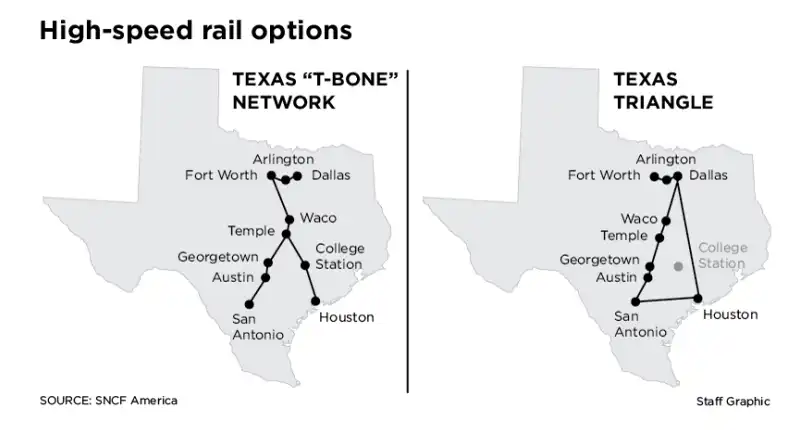
Instead of tearing up 240 miles of private rural property, SNCF’s proposal would merely require the slight widening of existing right-of-way. SNCF’s proposal would cost about half as much per mile to build. Its entire, 480-mile T-bone network could be built at a cost just slightly higher than a single leg of the 763-mile “Texas Triangle” Texas Central is proposing.