Update Regarding STB Petitions Filed By Texas Central

We have retained a specialist to help us put together a comprehensive response to the petitions. We have been working with him around the clock and are making good progress. We will be asking the Board to require Texas Central to file a full application, which would include all the information about the project that Texas Central has been hiding from the public.

As part of the response process, we will soon be contacting concerned Texas citizens, like you, to help us voice your opposition to the petitions as well. Stay tuned for more direction on this later today!

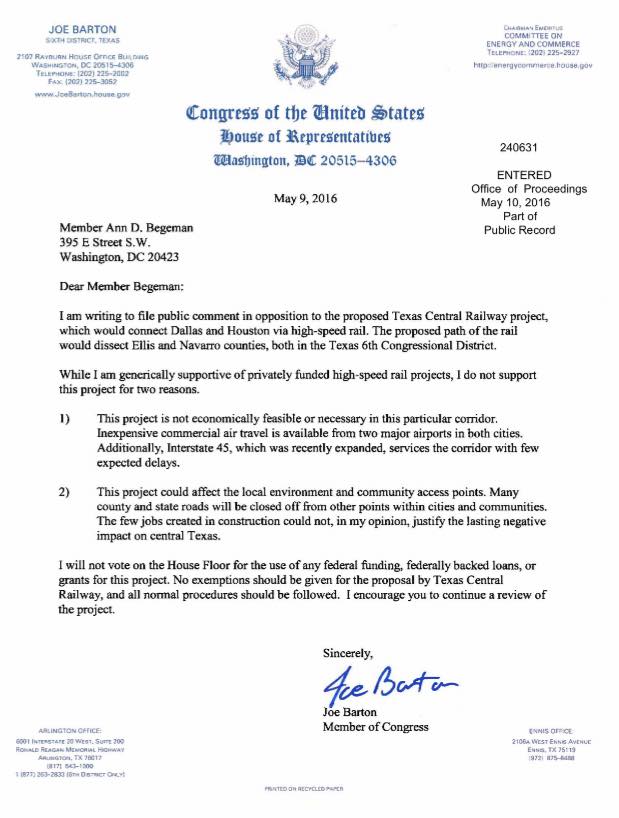
Yesterday, we filed a request for an extension to respond to the petitions. We think it is only fair that we be given sufficient time to get our response together, considering Texas Central spent months preparing their petitions. We are hoping to hear back from the Board regarding our request for an extension today or tomorrow. Attached is the letter we filed with the Board:

Texas Central Files Petitions With Surface Transportation Board

On April 19, Texas Central filed two petitions with the Surface Transportation Board — the independent federal commission that oversees railroads nationwide. These filings raise serious questions about Texas Central’s commitment to transparency and doing things “the right way.”

Texas Central is requesting an exemption from the regulations which govern the authority to construct and operate a railroad in the United States. Texas Central is also seeking a “clarification” that its project will be exempt from SB 18, the Texas landmark law limiting Eminent Domain abuse.

In the filings, Texas Central admits that it plans to take land from Texas private property owners “in locations not ultimately identified” on its final route because “its construction schedule is central to its business model.” TAHSR’s special litigation counsel Blake Beckham said, “In other words, Texas Central has no problem taking private property it does not even need for its project so long as the steady stream of funds from its Japanese partners keep flowing in. This is a clear concession that Texas Central does not have its financing in place, and yet it is asking for expedited consideration of its petitions in hopes that it can begin taking private property from Texas landowners immediately.”

TAHSR’s President Kyle Workman said, “The people of Texas fought long and hard to protect our property rights after the Kelo decision. Governor Perry and the Texas legislature worked together to enact SB18 specifically to provide Texans with protections against the abuse of Eminent Domain for private gain. TCR’s filing is an attempted end run around Texas law.”

Here are links to Texas Central’s filings with the Surface Transportation Board:

A little more on the petitions Texas Central filed with the STB…

In one of the petitions filed with the Surface Transportation Board, Texas Central references a report created by Insight Research Corporation titled “Texas Central’s High Speed Rail Corridor and Related Private Development Houston to Dallas/Fort Worth, Texas.” Based on this report, Texas Central claims that the high-speed train “could spur $36 billion in economic benefits, and generate nearly $2.5 billion in tax revenues to the state counties, local municipalities, school districts and other taxing entities, between 2015 and 2040.” Texas Central has bragged about these made-up claims on its website and through the press in a summary PowerPoint presentation titled “Texas Central Partners Economic Impact Report Summary.” But Texas Central won’t release the actual report itself, which should contain the objective data used to calculate all of these supposed economic benefits.

On April 21, we sent a letter to Texas Central’s attorney asking for a copy of this secret report. We don’t understand why Texas Central is hiding the report if it shows how great this project is going to be for the Texas economy.

If Texas Central is using this report in an attempt to get exemptions from federal railroad regulations, shouldn’t they have to disclose it to the public?

Here is a link to the letter we sent to Texas Central asking for the report. Texas Central has not responded to our request:

PRESS RELEASE April 28, 2016

FEDERAL FILINGS REVEAL JAPANESE-FUNDED RAILROAD CONSORTIUM PLANS EMINENT DOMAIN ABUSE AND NEAR WHOLESALE EXEMPTION FROM FEDERAL RULES

TCR Proposes to Acquire Land it Ultimately Won’t Use to Satisfy Investors

Jewett, Texas – Texas Central Railway (TCR), Central Japan Railway’s main US partner for the proposed Texas rail line, submitted two petitions on April 19 with the Surface Transportation Board (STB) – the independent federal commission charged by Congress to oversee railroads nationwide. These filings raise serious questions about the rail company’s commitment to transparency and the rule of law.

The filings, made available by the STB, reveal that Texas Central is requesting an exemption from 49 U.S.C § 10901, which governs the authority to construct and operate a railroad in the United States. In a second filing, Texas Central is seeking a “clarification” that its project will be exempt from SB 18, the Texas landmark law limiting Eminent Domain abuse.

The filings further reveal that the consortium plans to take land from Texas private property owners “in locations not ultimately identified” on its final route because “its construction schedule is central to its business model.”

Blake Beckham, special litigation counsel for TAHSR, said, “In other words, Texas Central has no problem taking private property it does not even need for its project so long as the steady stream of funds from its Japanese partners keep flowing in. This is a clear concession that Texas Central does not have its financing in place, and yet it is asking for expedited consideration of its petitions in hopes that it can begin taking private property from Texas landowners immediately.”

Kyle Workman, president of TAHSR, said, “The people of Texas fought long and hard to protect our property rights after the Kelo decision. Governor Perry and the Texas legislature worked together to enact SB18 specifically to provide Texans with protections against the abuse of Eminent Domain for private gain. TCR’s filing is an attempted end run around Texas law.”

Workman added, “Brazen doesn’t come close to describing these petitions. If they are granted, TCR could confiscate the property of landowners – even those not in the pathway of the track – as well as be exempt from most federal requirements for railroad construction. That’s a lose-lose situation for Texas landowners.”

“Notably absent from the petitions is any mention of the fact that this project will be funded almost entirely through government-backed loans and Japanese investors,” Workman concluded.

###

Download / Print

Lawsuit Against TCR Over Their Survey Permission Form

Now that we’ve updated you on the open records lawsuit against the AG and TxDOT, let’s turn our attention to the lawsuit filed against Texas Central over their survey permission form.

In the lawsuit filed by TAHSR member Jim Miles in Leon County, Jim asked the Court to rule that the survey permission form Texas Central is demanding landowners to sign is unlawful because it goes beyond the scope of what is allowed under Texas law. Jim is also asking the Court to rule that Texas Central doesn’t have the right to get on his private property. Here is a link to the lawsuit Jim filed:

On April 15, Texas Central responded to Jim’s lawsuit. Now they are saying that the survey permission form is … wait for it … VOLUNTARY, even though they’ve been telling hundreds of landowners that they MUST sign the form and let Texas Central on their land, or they will get sued. If it is voluntary like Texas Central is telling the Court in bold letters, then why are they suing landowners in Harris County to get on their property?

Texas Central is also telling the Court it can’t rule on Jim’s lawsuit. They claim the issue raised in Jim’s lawsuit is “moot” because they aren’t going to sue Jim “on the terms of the survey permission form.” But they are still trying to get on Jim’s land. It says so in the answer they filed with the Court.

So why is Texas Central telling the Court they aren’t going to sue landowners like Jim, when that is exactly what they are doing in Harris County? Why can’t Texas Central just be honest with Texas landowners and the Court?

Here is a link to Texas Central’s response in Jim Mile’s lawsuit:

Here are links to the lawsuits Texas Central filed in Harris County:

After Texas Central filed its answer to Jim Miles’ lawsuit in Leon County, Jim sent a proper notice to Texas Central to take the deposition of one of their representatives. Jim wants to know—under oath—why Texas Central thinks it has eminent domain authority and the right to enter his property to take a survey. Jim also wants to know if Texas Central has all of its money in place from its Japanese partners in order to finish construction of the high-speed train. Here is a link to Jim’s deposition notice:

Once again, Texas Central is refusing to send a representative, like CEO Tim Keith, to answer questions under oath. Instead, they filed another motion to “quash” the deposition. They also asked the Court for a protective order because they are afraid of giving any discovery related to the high-speed train.

Here is a link to the document Texas Central filed so that they don’t have to answer questions under oath or provide any information related to their project.

Request To TCR for Transparency

Now that the legal battles are moving forward in our fight against the high-speed train, we want to provide TAHSR supporters with updates on what is going on. We know these posts will be informative, showing you that we are challenging Texas Central at every turn. We also want you to see that although Texas Central keeps telling people they are a transparent organization that does things “the right way,” that is far from the truth.

In a letter sent to Texas Central’s attorney on April 18, we asked Texas Central to send us an unredacted copy of their Japanese partners’ “Feasibility Study” which contains an evaluation of Texas Central’s ridership projections and cost estimates for the high-speed train. Texas Central gave this study to the Texas Department of Transportation, but both Texas Central and TxDOT refuse to make it available to the public.

In the same letter, we also requested that Texas Central turn over a clean copy of its blacked-out legal brief, which it sent to the Attorney General in an effort to convince the Attorney General to let TxDOT withhold this information from the public.
Texas Central still has not responded to our letter.

Here is a link to the letter we sent, including a copy of the blacked-out letter brief Texas Central sent to us:

And there’s more…We sent a letter to the Texas Attorney General’s attorney on April 16 asking the Attorney General to turn over the blacked-out legal brief he received from Texas Central. Based on this legal brief, which was never disclosed to the public, the Attorney General allowed TxDOT to withhold Texas Central’s feasibility study, ridership projections and cost estimates even though they are public information. The Attorney General’s office responded to our letter, but he is refusing to disclose the legal brief. Here is a link to the letter we sent to the Attorney General:

READ THIS CLOSELY…Then prepare yourself for the next document…

In the open records case we filed against TxDOT to get Texas Central’s feasibility study, ridership projections and cost estimates, we sent a subpoena to Texas Central asking to take a deposition of one of their representatives, like Tim Keith. We want to know why he thinks it is proper to hide Texas Central’s information from Texas landowners whose private property they are trying to take through eminent domain to line the pockets of their Japanese partners. Here is a link to the deposition notice we sent to Texas Central:

You are going to need to sit down for this one…

Texas Central received our subpoena, but they are refusing to send a representative to sit for a deposition. Instead, they filed a motion asking the Court to “quash” the deposition so they don’t have to answer questions under oath. They are also asking the Court for a protective order so they don’t have to provide any discovery related to their Japanese partners’ feasibility study, or their ridership projections or cost estimates. Here is a link to the motion Texas Central filed: