FAMILIES UNDER THE RAIL – Batto & Miles Legacy

We’d like to share with you today a love story of sorts … the love of a generous couple for each other, the love they had for their community and country, a love-filled promise from one friend to another, and the love they all have for their home and ranch. The couple is Leo and Pinky Batto and the account of this story was given to us by Mrs. Barbara Miles, all of Leon County.

Keeping a Promise


Leo and Pinky Batto

Leo and Pinky Batto

Shortly after World War II ended Leo Batto, a native of Bandera, met Ben Beene, who had re-located to Bandera from Leon County. When Mr. Batto accompanied Mr. Beene back to the Jewett area, he was amazed at the abundance of grassy pastureland and decided it was the perfect place to make a home for himself and his new bride. As a veteran, he was able to purchase property six miles southwest of Jewett from the Barkley family out of the Underwood and Wilkerson surveys with assistance from the GI Bill. After moving his cattle from the Hill country to Central Texas and while making improvements to the nearly 700 acres, the Battos lived in several temporary residences, one of them being a log corn crib original to the property. They built their home in 1965. Mr. Batto worked at the Buffalo sale barn, but he was never happier than when he was home on his ranch with his dogs.


After working at the State Bank of Jewett and Hilltop Lakes Resort in the late 1950s and early 1960s, Mrs. Batto, known as Pinky to her friends, went to work in the Leon County Clerk’s office. During her years of service, Pinky became an unofficial authority on Leon County history, especially their ranch, which she researched extensively, piecing together its history. She learned that remains of a rock formation and depression referred to as “the Indian bowl” is located near the two miles of Brushy Creek that traverses the ranch. Native tribes were said to have used it to water horses and draw water for their camps. Numerous arrowheads have been excavated from the area. While exploring their property, the Battos also discovered remains of slave quarters farther down the creek bank. In the 1930s and 40s, the fertile creek bottom yielded an abundant cotton crop, which was hauled to the gin in Jewett.


During Jim Miles’ service as Leon County Commissioner for Precinct #3 (1992-2000), he and his wife, Barbara developed a very close and loving relationship with the Battos. Mr. Batto and Mr. Miles partnered in a cattle operation, with Mr. Miles taking over some of the aspects of ranch management that Mr. Batto was no longer able to perform. In the mid-nineties, Mrs. Batto was diagnosed with late stage cervical cancer. Having no other family to see to their needs, the Miles’ cared for Mrs. Batto until her death in 1999. During Pinky’s last days, she asked the Miles’ to take care of her beloved Leo, and their ranch; she never wanted it to suffer the fate that so many other large properties in the county had—being cut up and sold off piece by piece to “weekenders.” She knew that as a Leon County native, Jim understood the importance of the land, of their love of it. Pinky also wanted Jim to promise that she and Leo be buried in the old orchard near their home and that the Miles’ assume stewardship of the ranch—the place the Bandera natives called home for more than 50 years—and to preserve it in its entirety. Shortly before Leo’s death in 2006, the Miles’ built their home just west of the Batto home on what is now known as the It’ll Do Ranch.


Jim and Barbara Miles

Jim and Barbara Miles


Mr. and Mrs. Miles, who have been married since 1982, operate a cattle ranch and sell Angus Plus bulls. Several rescue animals call the ranch home as well, including a buffalo bison (“Bob”), a thoroughbred retired from the TAMU polo team (“Chi-Chi”), and a donkey (“Ruthie”). More than 25 species of birds live here. Though some were lost in the drought of 2011, there are several Water Oaks here that date back several centuries and measure more than 4 ft. through; some have a circumference of 18 ft.


Prior to their moving to their current residence, the Miles’ lived on Hwy 79, near Leon School. When a high-speed rail project proposed in 1992 threatened to destroy their home, they joined the grassroots movement that eventually derailed the project. They are determined to fight this latest threat as well, which is proposed to effectively cut their ranch in half, destroying years of work and more than a century and a half of history. Mrs. Miles, who directs the Jewett Historical Museum, also sees this as a threat to the local economy and area tourism, two things that small towns count on for survival.


The Miles’ will do what it takes to honor the Batto’s memory: the ranch will never be voluntarily split up and sold off as long as the Miles family owns it.

Stay tuned to Off The Rails for more from the Batto & Miles Legacy and from Families Under The Rail. If you would like us to feature your family legacy in Families Under The Rail, please contact us at info@TexansAgainsHSR.com today.

FAMILIES UNDER THE RAIL – Page Legacy

If you were watching CBS This Morning on March 12th, you may have seen a short interview with Rhonda Page Jordan from Waller County. We caught up with Rhonda so we could bring you more about her family legacy and the land that’s been in her family for over 130 years and is being threatened by this high-speed rail project.

1

The current generations of the family living on the Page Family Ranch.

When asked about the family legacy of her land, Rhonda said:

John William Page, Sr. and Mary McNeil Morris Windham, my great, great grandparents, married in 1864. Mary’s uncle, Joel Robison was a Colonel in the Texas revolution. April 22, 1836 was the day after the battle of San Jacinto and also the day he saved a Mexican soldier’s life. Upon the threat of being shot after refusing to walk further after capture, Colonel Robison reached out and pulled the soldier horseback behind him, noticing white satin cuffs under a common soldier’s suit. Once delivered to General Sam Houston, the Mexican soldier revealed he was, in fact, General Antonio Lopez de Santa Anna. In gratitude, the General later gave his gold brocade vest complete with gold buttons to Uncle Joel, which was then shared with bridegrooms from surrounding counties.


2

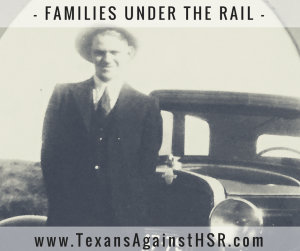
Taken in 1932 of M L (Bud) Page.

John and Mary Page went on to have a son, John William, Jr., who married Helen Hegar, daughter of Alfred and Helen Hegar, in April 1864. They began their lives farming 48 acres in Hegar, Waller County, Texas, in 1881, growing his spread to 350 acres and, later choosing ranching as a way of life. The Great Depression forced my grandparents to move to Houston to make their living, but Grandpop held the land even during those hard times. My father, the eighth child of eleven born to Alfred and Helen, and his brother, James August (second son) went on to continue their father’s legacy of raising Registered Red Brahman cattle. Both lived here until they passed.


It is on Page Ranch that my family also lives. My sister makes her home here. My mother, at age 96, resides here raising a small herd of commercial cattle with my brother and his family. My husband, Doug, and I partner a commercial cattle herd here with our daughter, her husband and family, who also built their only home here. Together our lives center around the children, grandchildren, horses, chickens, cattle and hay raised on Page Ranch. Living here forty years, this is the only home Doug and I have owned. We are fortunate God has given us the ability to live and to enjoy the abundant wildlife here. We are blessed to have children who watched animals being born and dying; who bottle-fed calves and pigs, who returned baby birds to their nests. There are no words to explain what the loss of our ranch means to us.

3

Taken in 2005 of 3 of the 6 generations who have lived on the Page Family Ranch.


This is our home Texas Central Railway threatens to take. Loss of income due to loss of acreage for pasture and hay, with no way to recover loss of property value or use, are unnecessary losses. Disruption of human lives, domestic livestock and wildlife, change in water flow and retention, and decimation of grazing pastures doesn’t begin to explain the changes one could expect, and that is only during construction of a high-speed rail. Constant noise and movement, near constant trains blasting through the quiet peacefulness is not an 1adjustment, it is an alteration. Terrorism threats, derailments and loss of wild and domestic life is not taken lightly. These can be prevented. Texas is a land of ranchers, farmers, property owners. It is a heritage, a way of life. Are Texans willing to trade private property ownership for eminent domain and a Japanese train? Rural Texans aren’t and we pray for the support of those who live in cities, but enjoy a quiet country drive or bicycle ride.
Stay tuned to Off The Rails for more from the Page Legacy and from Families Under The Rail. If you would like us to feature your family legacy in Families Under The Rail, please contact us at info@TexansAgainsHSR.com today.

FAMILIES UNDER THE RAIL – DuBois Legacy

Last month, Tom DuBois was one of over 50 people who traveled to Austin to support HB 1876 and HB 1889. Throughout the day, we were able to learn about the history of several pieces of property targeted by the Dallas Houston HSR proposed routes. We visited again with Mr. DuBois and his wife, Debbie, at their home in Leon County where they operate a purebred and commercial cow/calf operation.

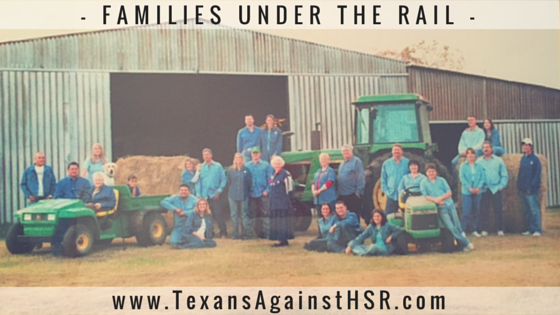
The DuBois Family Ranch has been home to 5 generations of the family, currently owned by Tom & Debbie DuBois.

When asked about the family legacy of his land, Tom said:

2

Tom DuBois’ father, Thomas Samuel DuBois, was born in this house on July 31, 1912.

I’ve had family members on both my father’s and mother’s side residing in Leon County since the mid 1800’s. My grandfather, Norman G. DuBois, first purchased part of this place on January 8, 1898, and continued adding to it until 1927. Following the storm of 1900 in Galveston, my grandmother rode a wagon train with her family to Leon County, and her father passed away on the trail along the way. After marrying in the early 1900’s, my grandparents were farmers, raising four children, corn and cotton and selling cord wood to pay for the land. My grandfather never owned an automobile, and all he and my grandmother knew was hard work. My father and mother had to leave the farm during the depression, as the place could not provide a living for both my grandparents and parents during that time.


Our home place is currently owned by myself, and my wife, Debbie. Our three daughters were the fifth generation to grow up and live here. Our daughters are devoted to this land, and my wife and I will do whatever it takes to protect it and our way of life. I hope you can see just how important the piece of land is to our family and their future.

How will your cow/calf operation be impacted if the high-speed rail comes through your property?

We currently run our operation on a little over 500 acres. This includes owned and leased agreement properties. We have to move our cattle from time to time when water or grass is limited in a certain area. We rely on access to existing county and private roads to minimize the distance we must travel with the livestock on the highway. If some roads in the county are closed or access is limited, this will have a huge burden on us. Even with occasional access culverts, the time, the money and the distance we could travel adds to the cost of operation.


The same applies when we have to move equipment to the hay fields to bale and transport the hay to the winter feeding areas. Not to mention if this train right of way crosses any of our operation property splitting the land in half. Now I would possibly not have water on that side of the pasture. Access culverts do not address how the high earthen berms would block water runoff that we rely on to feed our ponds for watering our cattle.

How have the proposed HSR routes already impacted your property? And do you have other concerns?

We already see the property values moving downward, and properties currently on the market are creating little interest because of this HSR threat. Having an abundance of deer on our properties, deer hunting is a huge revenue source for many ranchers. What will the noise and vibration do to these herds of deer? And will there be deer hunting restrictions that would come with this train concerning the use of high powered rifles in and around the track? Also, who has the liability if livestock or wild game (deer or hogs) do get on the train right of way? Wild game do go through the best of fences.

We Must Stop This Train.

Stay tuned to Off The Rails for more from the DuBois Legacy and from Families Under The Rail. If you would like us to feature your family legacy in Families Under The Rail, please contact us at info@TexansAgainsHSR.com today.

FAMILIES UNDER THE RAIL – Finch Legacy

We’d like to share a candid interview with one of the many affected families of this high-speed rail project. We spoke with Randa Calhoun, whose family property is located in Grimes County and this is what she shared with us:

Finch Legacy: A Beautiful Gift to Preserve Forever!

4-F Ranch is home to George and Doretta Finch, their daughter Rysa and her son, their daughter Randa & her husband Charlie and their twin boys.

Randa describes her family’s home as:

These 600+ acres have served as acres of joy for our entire family as well as friends and in-laws. It is our little Utopia! We have worked together to make it the show place it has become. Every weekend is a family reunion for us. Friends and family are always calling asking if they can come for the weekend and bring their family and animals. Our gate is always open to share the beauty and Glory of our lives. We have been blessed. We enjoy working with our friends and family and then sitting back and admiring together what God has bestowed upon us. 4-F Ranch was never meant for a high-speed rail system. It was meant for mankind and animals to respect the nature God has created. Glory be to God!

When asked a  little about the history of the property and how it came to be what it is today, Randa says:

My parents, George and Doretta, did not grow up in families that had anything to pass down to the next generation. They knew when they first married that they would leave their children land that would continue to be left for the generations to come. They worked their entire life to save money for the purchase of this land. At times, this included them each working more than one job to ensure money was put back for their dream to become a reality.


Randa goes on to say:

Our land offers so much use to our family. We all are prideful of our cow-calf operation. The land is also used for hay production, recreation, homestead, and future retirement. Charlie, Randa, and their twin boys use the land for their show pig operation, CR 125 Genetics, that sells show pigs to 4-H and FFA students across the nation. In addition, the land provides daily, spontaneous lessons to their twins and nephew about nature, the circle of life, and God’s creations.

We asked Randa these questions:

  • How will having this high-speed rail through your property affect your current or future use of it?
  • How will it disrupt your way of life?
  1. There are several concerns with having this high-speed rail through our property. We are worried about the negative effects of the vibration and noise levels. Our concerns are what factors these two obstacles will play on the stress level of the reproduction and health of the livestock and the beautiful wildlife that shares our property with us. Will the wildlife be forced to move on and find a more peaceful living environment? Leaving behind the livestock to deal with less land to graze and less hay for the winter months since the hay fields will have diminished due to the obstruction of cattle movement and access to property created by the Dallas Houston High-Speed Rail.

  2. My family has worked hard to do improvements to our place. We have built a large equipment barn, a hay barn, a covered working pen, and numerous fencing projects which should add value to our property, but with this high-speed rail system, we will be faced with decreasing property values.

  3. We are also concerned about the disruption to the aesthetics of our property from the undisturbed nature as well as to the fish and our ponds. The safety of our family remains an area of concern. Our family bought this property to be able to experience its beauty, produce agriculture on it, and create memories as a family. It is not right that a private company can come in and destroy this for their benefit.

Stay tuned to Off The Rails for more from the Finch Legacy and from Families Under The Rail. If you would like us to feature your family legacy in Families Under The Rail, please contact us at info@TexansAgainsHSR.com today.