TCR Fighting Rider 48

Ironically, TCR has made it very clear they intend to use state funds for the project they have been touting as “entirely privately funded.” Despite their extensive team of lobbyists who have been working behind the scenes, they are now asking Texans to contact their legislators to OPPOSE Rider 48, which would prohibit use of state funds for subsidizing or assisting with construction but allow coordination and oversight of HSR projects. Rider 48 is simply a taxpayer protection. If TCR can’t afford to pay for their project, we shouldn’t have to.

If not having access to state funds makes their project cost prohibitive, their main selling point of “entirely privately funded” is just as misleading as their information on routes and station locations. Check out what the Federal Railroad Administration had to say about this “premature” information in this article on Community Impact Newspaper.

One last thing … Dallas Mayor Rawlings and TCR have been promoting this rider as “trickery.” Riders are provisions within the budget that specify how state funds can and cannot be used. No trickery…it’s part of the process.

If you haven’t already, please TAKE ACTION NOW by visiting our that tab on website where you can email the budget committee members directly to voice your support for Rider 48.

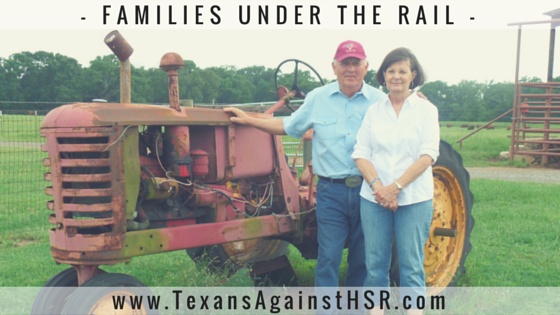
FAMILIES UNDER THE RAIL – DuBois Legacy

Last month, Tom DuBois was one of over 50 people who traveled to Austin to support HB 1876 and HB 1889. Throughout the day, we were able to learn about the history of several pieces of property targeted by the Dallas Houston HSR proposed routes. We visited again with Mr. DuBois and his wife, Debbie, at their home in Leon County where they operate a purebred and commercial cow/calf operation.

The DuBois Family Ranch has been home to 5 generations of the family, currently owned by Tom & Debbie DuBois.

When asked about the family legacy of his land, Tom said:
2

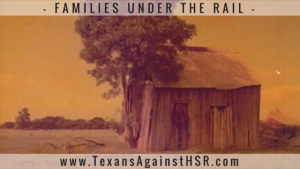
Tom DuBois’ father, Thomas Samuel DuBois, was born in this house on July 31, 1912.

I’ve had family members on both my father’s and mother’s side residing in Leon County since the mid 1800’s. My grandfather, Norman G. DuBois, first purchased part of this place on January 8, 1898, and continued adding to it until 1927. Following the storm of 1900 in Galveston, my grandmother rode a wagon train with her family to Leon County, and her father passed away on the trail along the way. After marrying in the early 1900’s, my grandparents were farmers, raising four children, corn and cotton and selling cord wood to pay for the land. My grandfather never owned an automobile, and all he and my grandmother knew was hard work. My father and mother had to leave the farm during the depression, as the place could not provide a living for both my grandparents and parents during that time.


Our home place is currently owned by myself, and my wife, Debbie. Our three daughters were the fifth generation to grow up and live here. Our daughters are devoted to this land, and my wife and I will do whatever it takes to protect it and our way of life. I hope you can see just how important the piece of land is to our family and their future.

How will your cow/calf operation be impacted if the high-speed rail comes through your property?
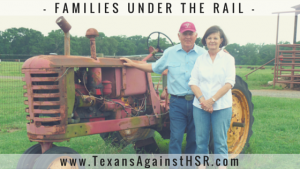
We currently run our operation on a little over 500 acres. This includes owned and leased agreement properties. We have to move our cattle from time to time when water or grass is limited in a certain area. We rely on access to existing county and private roads to minimize the distance we must travel with the livestock on the highway. If some roads in the county are closed or access is limited, this will have a huge burden on us. Even with occasional access culverts, the time, the money and the distance we could travel adds to the cost of operation.


The same applies when we have to move equipment to the hay fields to bale and transport the hay to the winter feeding areas. Not to mention if this train right of way crosses any of our operation property splitting the land in half. Now I would possibly not have water on that side of the pasture. Access culverts do not address how the high earthen berms would block water runoff that we rely on to feed our ponds for watering our cattle.

How have the proposed HSR routes already impacted your property? And do you have other concerns?

We already see the property values moving downward, and properties currently on the market are creating little interest because of this HSR threat. Having an abundance of deer on our properties, deer hunting is a huge revenue source for many ranchers. What will the noise and vibration do to these herds of deer? And will there be deer hunting restrictions that would come with this train concerning the use of high powered rifles in and around the track? Also, who has the liability if livestock or wild game (deer or hogs) do get on the train right of way? Wild game do go through the best of fences.

We Must Stop This Train.
Stay tuned to Off The Rails for more from the DuBois Legacy and from Families Under The Rail. If you would like us to feature your family legacy in Families Under The Rail, please contact us at info@TexansAgainsHSR.com today.

Reason Foundation HSR Report Highlights

Since TCR has recently stated in their Rumors vs. Reality document that they agree with a report on HSR in the US by Reason Foundation, a well respected think tank, we’ve highlighted some interesting findings within the report for your convenience. The entire 39-page report can be found here, but you can read, download and print the highlights we compiled by clicking the image below.

Front Page

FAMILIES UNDER THE RAIL – Finch Legacy

We’d like to share a candid interview with one of the many affected families of this high-speed rail project. We spoke with Randa Calhoun, whose family property is located in Grimes County and this is what she shared with us:

Finch Legacy: A Beautiful Gift to Preserve Forever!

4-F Ranch is home to George and Doretta Finch, their daughter Rysa and her son, their daughter Randa & her husband Charlie and their twin boys.

Randa describes her family’s home as:

These 600+ acres have served as acres of joy for our entire family as well as friends and in-laws. It is our little Utopia! We have worked together to make it the show place it has become. Every weekend is a family reunion for us. Friends and family are always calling asking if they can come for the weekend and bring their family and animals. Our gate is always open to share the beauty and Glory of our lives. We have been blessed. We enjoy working with our friends and family and then sitting back and admiring together what God has bestowed upon us. 4-F Ranch was never meant for a high-speed rail system. It was meant for mankind and animals to respect the nature God has created. Glory be to God!

When asked a  little about the history of the property and how it came to be what it is today, Randa says:

My parents, George and Doretta, did not grow up in families that had anything to pass down to the next generation. They knew when they first married that they would leave their children land that would continue to be left for the generations to come. They worked their entire life to save money for the purchase of this land. At times, this included them each working more than one job to ensure money was put back for their dream to become a reality.


Randa goes on to say:

Our land offers so much use to our family. We all are prideful of our cow-calf operation. The land is also used for hay production, recreation, homestead, and future retirement. Charlie, Randa, and their twin boys use the land for their show pig operation, CR 125 Genetics, that sells show pigs to 4-H and FFA students across the nation. In addition, the land provides daily, spontaneous lessons to their twins and nephew about nature, the circle of life, and God’s creations.

We asked Randa these questions:

  • How will having this high-speed rail through your property affect your current or future use of it?
  • How will it disrupt your way of life?
  1. There are several concerns with having this high-speed rail through our property. We are worried about the negative effects of the vibration and noise levels. Our concerns are what factors these two obstacles will play on the stress level of the reproduction and health of the livestock and the beautiful wildlife that shares our property with us. Will the wildlife be forced to move on and find a more peaceful living environment? Leaving behind the livestock to deal with less land to graze and less hay for the winter months since the hay fields will have diminished due to the obstruction of cattle movement and access to property created by the Dallas Houston High-Speed Rail.

  2. My family has worked hard to do improvements to our place. We have built a large equipment barn, a hay barn, a covered working pen, and numerous fencing projects which should add value to our property, but with this high-speed rail system, we will be faced with decreasing property values.

  3. We are also concerned about the disruption to the aesthetics of our property from the undisturbed nature as well as to the fish and our ponds. The safety of our family remains an area of concern. Our family bought this property to be able to experience its beauty, produce agriculture on it, and create memories as a family. It is not right that a private company can come in and destroy this for their benefit.

Stay tuned to Off The Rails for more from the Finch Legacy and from Families Under The Rail. If you would like us to feature your family legacy in Families Under The Rail, please contact us at info@TexansAgainsHSR.com today.

FRA Releases Scoping Reports

The Federal Railroad Administration just released its Scoping Report for the Dallas Houston HSR project, which is a summary of all comments and questions received during the public scoping period with the FRA response. Below you will find the Scoping Report and Appendix E (Summary of Comments). We have highlighted portions of the summary that you may find of particular interest, including things like TSA is responsible for passenger train security screening, the FRA is conducting this EIS but ridership data (which would indicate the viability of the entire project) is not under their purview, and the Draft EIS will identify a preferred alternative (route) pursuant to the guidelines for “Accelerated Decision-making in Environmental Reviews.”

The Scoping Report is an interesting read for sure…AND the summary of comments (Appendix E) is 289 pages of excellent reasons to support the NO BUILD option!

Click thumbnail to download or print.

Click thumbnail to download or print.

Click thumbnail to download or print.

Click thumbnail to download or print.

You can find other appendices and the original location of the report here. (http://www.fra.dot.gov/Page/P0780)