As you may know, High-Speed Rail was subject to a highly unusual and highly publicized vote last night by the committee making final decisions on the state budget. After requesting that budget writers confirm that there is no current authorization for state support of high-speed rail, the committee voted 6-4 against a proposal by Senator Schwertner to place language in the budget explicitly forbidding the Texas Department of Transportation from spending any state money to facilitate the project. Senator Joan Huffman, who voted against the rider, emphasized that the vote should not be interpreted as support for the proposed HSR project, which she believes needs more study and should not begin without further evaluation from the State.
Texas Central Railway argued that Senator Schwertner’s proposed rider would kill their project as the Texas Department of Transportation has to be involved in planning and oversight; however, the last known version of the rider included language that would have allowed for TxDOT coordination and oversight. We know that no HSR project has ever existed without government subsidies, which is why we supported Senator Schwertner and his rider. However, in spite of the technical outcome of this vote, the committee sent a clear message to the Dallas Houston HSR investors and lenders, along with TxDOT, that State money will not be available for the project and included provisions, consistent with legislation supported by Texans Against High-Speed Rail, which require notice and reports to be made to local officials before a passenger rail project can begin in Texas.
Although the legislative session is coming to a close, Texans Against High-Speed Rail will continue to work with legislators as the issues related to HSR continue to be debated on transportation bills still under consideration by the Texas Legislature. We will keep you informed on how you can weigh in on those bills. Despite the rigorous pace of the legislative session and the urgency associated with our efforts, we must remain steadfast in our long term opposition plan. We thank you for the important role you have played, and will continue to play, in support of Texans Against High-Speed Rail and legislation that will protect landowners from losing their land and their heritage to an ill-conceived rail project that is not right for Texas.
You can read or listen to the discussion by the State Budget Conference Committee and the Legislative Budget Board below in the transcript or by clicking the red link for the video (NOTE: the discussions about Rider 48 begin at 5:22) …. Appropriations: Conference Committee Meeting on HB1 – May 21st, 2015.
Rider 48, High-Speed Rail Limitations
Budget Conference Committee Hearing
84th Texas Legislature
May 21, 2015
Senator Charles Schwertner –
“I’d like to make a statement, Mr. Chairman.”
Chairman John Otto –
“Sure, Senator Schwertner.”
Senator Charles Schwertner –
“Thank you Mr. Chairman. Members, this rider is about protecting the taxpayers, citizens, and property owners here in Texas. This rider is not put forth to the Senate Finance Committee in the dead of the night or through a backdoor maneuver, as I’ve read in the press. This was openly discussed in a unanimous decision coming out of the Senate Finance Committee in, subsequently, a 30 to 1 vote on the floor of the Senate. Simply put, this proposal of a high-speed rail in Texas has been sold to the people of Texas, and the taxpayers of Texas, and to members of this legislature that it will never require state taxpayer dollars to help with it’s operation or upkeep or construction. And I believe when a private enterprise promotes that promise, it should be held to account. And this rider does that. Simply put, it says that no state taxpayer dollars will be utilized in the construction of high-speed rail. It’s very simple. And it corresponds, of course, with the promise that has been made by private enterprise. However, I believe when you look across the countries and actually the entire world, there has never been a high-speed rail that has not received subsidization by the state or the government. So, I believe we’re being sold a potential bill of goods. Um, and I believe in the long-term that the citizens and the taxpayers are going to be left holding the hook … and that’s already occurred actually. The federal government, with the proposals for the building of this high-speed rail, have already put forth a TIFIA Loan, which is a $5 Billion federal infrastructure loan, which is subordinated debt, which means it comes … the repayment of that debt comes after repayment of the other aspects … other obligations of that enterprise. So, I, again, believe that we need to as a legislature, take a strong stand that the state of Texas, when told that they are not going to need state taxpayer dollars … hold them to account. And that’s all this rider did. So with that, I appreciate the opportunity, at least, to state my point of view regarding this rider. Um, and my attempt to try to, again, protect the taxpayers and property owners here in the State of Texas.”
Chairman John Otto –
“Senator Kolkhorst.”
Senator Lois Kolkhorst –
“Thank you Mr. Chairman. For clarification in moving the Senate that means that there will be no rider that speaks to the high-speed rail project, is that correct?”
Chairman John Otto –
“This is a motion to adopt the Conference Committee recommendation which is House, which would be … there would be no rider.”
Senator Lois Kolkhorst –
“That’s correct. And I just want to reiterate what Senator Schwertner said about the rider being discussed in the Senate. I had a bill, Senate Bill 1601, as well, that would have taken eminent domain authority away from this private company, and in those discussions that passed out of the transportation committee, it was said several times that this was a project that would not utilize any taxpayer dollars. And I think that the spirit of the rider in the Senate reflects what they had stated numerous times publicly. And so I appreciate you allowing us to sever this to represent our districts, whose land will be greatly affected by this, and I agree with Senator Schwertner that this could potentially have grave consequences for the State of Texas. Thank you.”
Chairman John Otto –
“Ok. Senator Huffman.”
Senator Joan Huffman –
“Thank you, Mr. Chairman and members. I’d like to support my fellow Senators here and say that, and to speak up for Senator Schwertner, to say that this was not done in the dead of night. It was discussed in the Senate. Also I’d like to state publicly that I am going to vote yes and concur with the House to ensure that the process moves along. I hope that agreeing to look at this further does not mean or is misinterpreted as being in support necessarily of the project. So, I think that’s an important message to be heard. It’s something that will be discussed, and researched, and looked at, and that’s simply what these votes mean. I just wanted to state that. Thank you very much.”
Chairman John Otto –
“Senator Kolkhorst.”
Senator Louis Kolkhorst –
“Mr. Chairman, one more follow up for you and Chair Nelson is that there is no money appropriated in this money for the high-speed rail, am I correct on that Chairs?”
Chairman John Otto –
“My understanding is that not only is there no money appropriated for this, they don’t currently have the authority to do this under … uh, the way that the way that the Fund 6 is set up. It would only be if there was whatever discretionary money might be there. And my understanding is that’s all spoke … that’s all appropriated.”
Chairman John Otto –
“Chair Nelson.”
Senator Jane Nelson –
“Mr. Chairman, that is my understanding as well, but I would like to ask the Legislative Budget Board to verify that if that’s possible.”
Legislative Budget Board –
“That is correct. There is no money in this budget for high-speed rail projects.”
Senator Jane Nelson –
“Thank you.”
Chairman John Otto –
“Senator Schwertner.”
Senator Charles Schwertner –
“Yes, but I’d like to also… thank you, Mr. Chairman. The Mobility Fund does a lot of expenditure, although it’s oversubscribed to projects such as high-speed rail, is it not?”
Legislative Budget Board –
“Yes, that is correct, but you are also correct about it being oversubscribed.”
Senator Charles Schwertner –
“Alright. So, again, this message is out to the taxpayers and property owners that this project is being sold to the people of Texas as something that will never require state backing or subsidization or bailing out, and unfortunately I think that is a complete fallacy, and one that we will rue the day that we do not stop it up front. Thank you, Mr. Chairman.”
Senator Lois Kolkhorst –
“Thank you. Mr. Chairman.”
Chairman John Otto –
“Members, we are now going to take the vote as … let me just go back over it … if you vote … this is a motion to adopt the Conference Committee Work Group Recommendation to adopt House. So a no vote means you do not wish to adopt the Conference Committee Recommendation of House … a yes vote means you do want to adopt the Conference Committee of House. If there are no further questions, Representative Gonzales moves the adoption of the Work Group Recommendation for this severed item. Are there any objections? If not, clerk will call the roll.”
Clerk –
“Chair Otto”
Representative John Otto –
“No.”
Clerk –
“Chair Nelson”
Senator Jane Nelson –
“Yes.”
Clerk –
“Turner”
Representative Sylvester Turner –
“Yes.”
Clerk –
“Davis”
Representative Sarah Davis –
“Yes.”
Clerk –
“Gonzales”
Representative Larry Gonzales –
“Yes.”
Clerk –
“Ashby”
Representative Trent Ashby –
“No.”
Clerk –
“Hinojosa”
Senator Chuy Hinojosa –
“Aye.”
Clerk –
“Huffman”
Senator Joan Huffman –
“Yes.”
Clerk –
“Schwertner”
Senator Charles Schwertner –
“No.”
Clerk –
“Kolkhorst”
Senator Lois Kolkhorst –
“No.”
Chairman John Otto –
“There being 6 Aye’s and 4 Nay’s, the motion is adopted.”




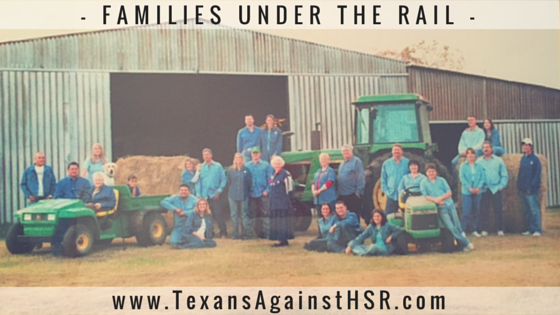
 adjustment, it is an alteration. Terrorism threats, derailments and loss of wild and domestic life is not taken lightly. These can be prevented. Texas is a land of ranchers, farmers, property owners. It is a heritage, a way of life. Are Texans willing to trade private property ownership for eminent domain and a Japanese train? Rural Texans aren’t and we pray for the support of those who live in cities, but enjoy a quiet country drive or bicycle ride.