PRESS RELEASE January 12, 2016

TEXAS OFFICIALS VOW TO OPPOSE JAPANESE RAIL PROJECT

Jewett, Texas – Yesterday, thirty-three Texas officials sent a letter to The Honorable Kenichiro Sasae, Japan’s Ambassador to the United States, pledging to oppose the Dallas to Houston High-Speed Rail (“HSR”) Project proposed by Japanese rail interests. Elected and appointed officials representing the areas that will see irreversible harm to communities and property values, while having no benefit to citizens, including state legislators, county judges, county commissioners and sub-regional planning commission members, have all signed the letter.

Grimes County Judge Ben Leman said, “This letter sends a strong message that after considering all the information available, there is even more opposition to this HSR Project. Citizens clearly do not want this HSR to trample on the Texas constitutional protection of private property rights for the benefit of Japanese businesses. This Project is simply not viable in Texas, and the Japanese should look to other markets where there is local support.”

The letter reflects the overwhelming local opposition to the Project and follows a Legislative session in which the Texas Senate overwhelming supported a rider on the appropriations bill prohibiting any state support for HSR. Ultimately, the rider was removed only after the Texas Department of Transportation testified that they are not authorized to provide support for the HSR Project under current law. To date, no HSR Project has ever been completed and operated without significant public financing.

Leman went on to say, “As a County Judge whose county would be decimated by this unnecessary rail project, I will do everything within my power to protect the health, safety and welfare of our citizens.”

Texans Against High-Speed Rail represents a broad coalition of Texans who oppose the proposed HSR Project and garnered support for the letter to Ambassador Sasae. Kyle Workman, president of Texans Against High-Speed Rail, stated, “We appreciate the support of our officials in opposing this HSR project. This project is not just an issue of unwarranted use of eminent domain, but also one of eventual taxpayer subsidies that will impact all Texans. Our officials understand the full magnitude of the damage that can be done because of this, and I applaud their fortitude in standing with and for the citizens they represent on this issue.”

Please visit www.TexansAgainstHSR.com for more information about Texans Against High-Speed Rail, Inc.

Click here to view the letter to Ambassador Sasae.

###

Download / Print

Vice President Biden: High-Speed Rail in Texas is Worth the Risk?

In November 2014, Texans overwhelmingly passed a constitutional amendment that diverted general revenue to funding roads. Just one year later, Texans hit the polls again and with a resounding 83% calling for more road funding by passing Proposition 7. Texans have sent a clear message. They want their roads! Texans love the independence that roads bring. The proposed Dallas to Houston High-Speed Rail project is not mass transit. And it most definitely will not solve the intra-city traffic problems of Dallas and Houston; nor will it solve the nonexistent intercity traffic jam on I-45. This proposed project will only serve a very narrow segment of the population that can afford to pay costs comparable to that of an airline ticket. Let’s remember, also, that high-speed rail is “successful” (not profitable, though) only where traditional passenger rail is already successful. When was the last time you rode a train full of commuters between Houston on Dallas?

Photo courtesy of The Dallas Morning News

Vice President Joe Biden was in Dallas this week championing for the Dallas Houston project, calling it “vital for America to prosper in the 21st century.” While at this event, Vice President Biden was quoted as saying, “Ten years from now, you will look back on the risk you took,” acknowledging the obvious risks associated with the project. High speed rail worldwide is heavily subsidized. The inevitable taxpayer takeover of this project is not a risk that Texans can afford.

With his visit to promote the HSR, Vice President Biden highlighted the desire of the Obama administration to see HSR throughout the US and specifically in Texas. However, several factors indicate this is too risky of a project for Texans. Representatives of Texas Central are on record stating numerous times that the Japan Bank for International Cooperation will be the largest debt provider for the project. Hopefully, the Japanese government will recognize the lack of viability for this project. With a Japanese public-private partnership in the works to cover some $40million of the project, the Japanese public should be concerned as well.

The Dallas Morning News has quoted Texas Central Senior Advisor, and former Dallas mayor, Ron Kirk as stating that Texas Central will “aggressively pursue” federal loans if they are available.  This “privately” funded project is becoming more and more public. Borrowing money from the government for a project that is destined for government control is simply a bad idea.

Another blow to the project is that now, due to environmental and cost constraints, this is no longer a downtown to downtown project. The project is slated to stop outside the Houston at HWY 290 and the 610 Loop. Riders heading downtown would need to find alternative transportation to reach their final destination.

As VP Biden calls for HSR in Texas, the citizens of Texas, who overwhelming do not support the current administration, really should be questioning the validity of this high-speed rail project. Our property rights, taxes and way of life all hang in the balance.

Texas Central claims “free movement”

Click to enlarge. Will open in a new window. Check your pop-up settings.

Click to enlarge. Will open in a new window. Check your pop-up settings.

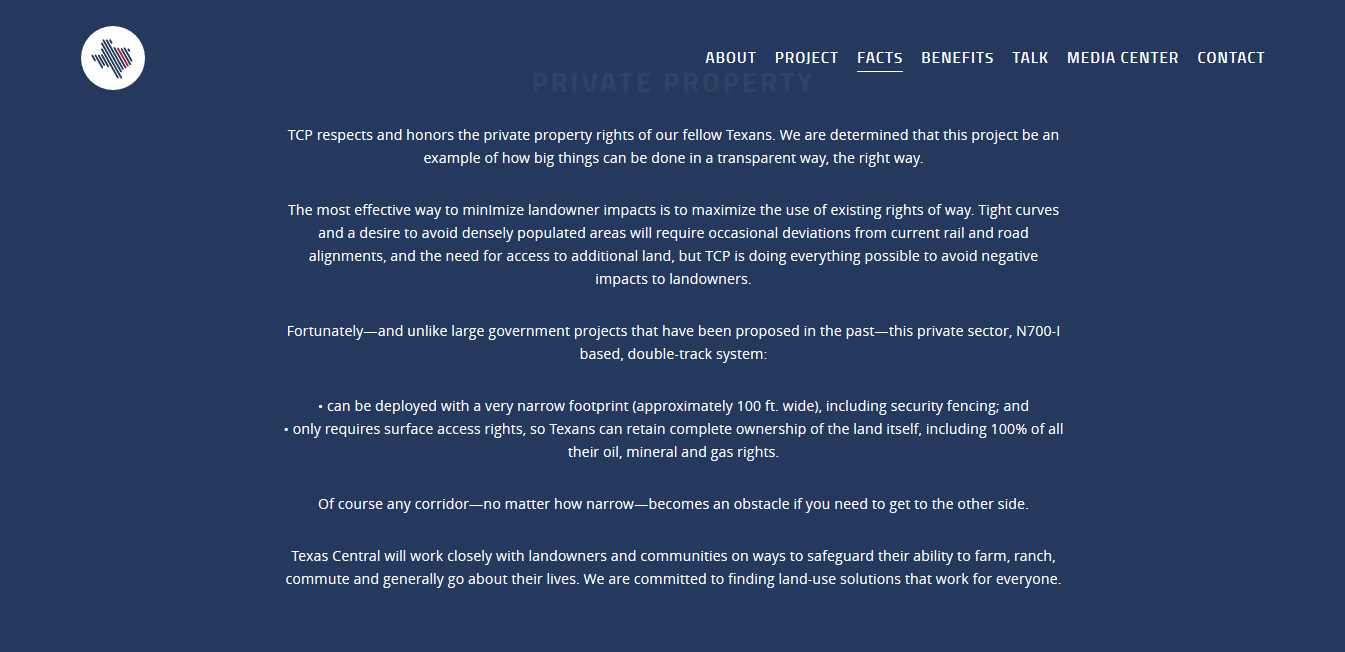
Texas Central claimed today on their Facebook page that their “engineers are designing the high-speed railway with landowners in mind by creating FREQUENT and CONVENIENT points of elevated train tracks. Free movement of people, equipment, vehicles, livestock and wildlife is one of our main priorities.” However, on their own website they refer to their tracks as an obstacle by stating, “Of course any corridor—no matter how narrow—becomes an obstacle if you need to get to the other side.”

Click to enlarge. Will open in a new window. Check your pop-up settings.

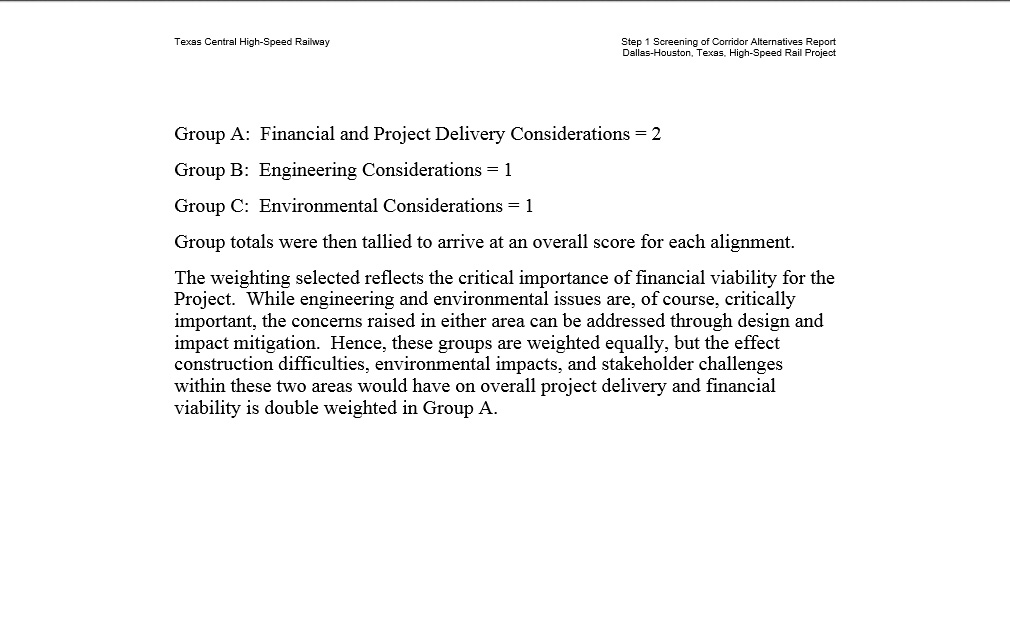
Currently, people, equipment, vehicles, livestock and wildlife move freely without any enclosed high-speed rail track impeding movement. Upon review of Texas Central’s Step 1 Screening of Corridor Alternatives Report there is no mention of free movement as one of their priorities. It is clear their priorities are financially driven. Page 22 of the report states the evaluation criteria used for weighting the corridor selection process is that financial and project delivery consideration is double weighted compared to engineering and environmental considerations.

Click to enlarge. Will open in a new window. Check your pop-up settings.

Click to enlarge. Will open in a new window. Check your pop-up settings.

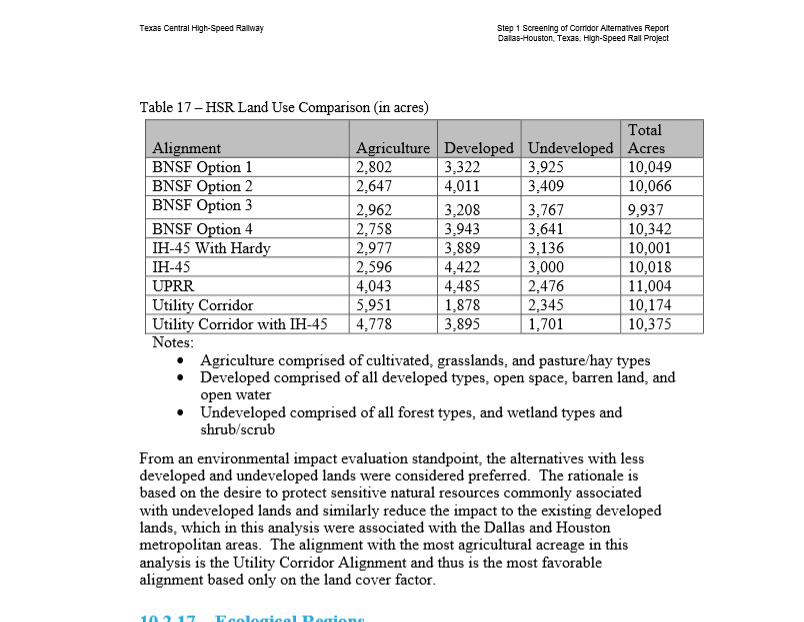
Therefore, “The weighting selected reflects the critical importance of financial viability for the Project.” Page 132 states, “From an environmental impact evaluation standpoint, the alternatives with less developed and undeveloped lands were considered preferred.” It goes on to say, “The alignment with the most agricultural acreage in this analysis is the Utility Corridor Alignment and thus is the most favorable alignment based only on the land cover factor.” Page 140 is the “Corridor Evaluation Stoplight Chart.”  While the evaluation considers many factors including financial viability, ROW acquisition, constructability issues, crossings, and prime farmland, there is no consideration for “free movement,” which is odd since they claim it to be a “priority.”

Click to enlarge. Will open in a new window. Check your pop-up settings.

Click to enlarge. Will open in a new window. Check your pop-up settings.

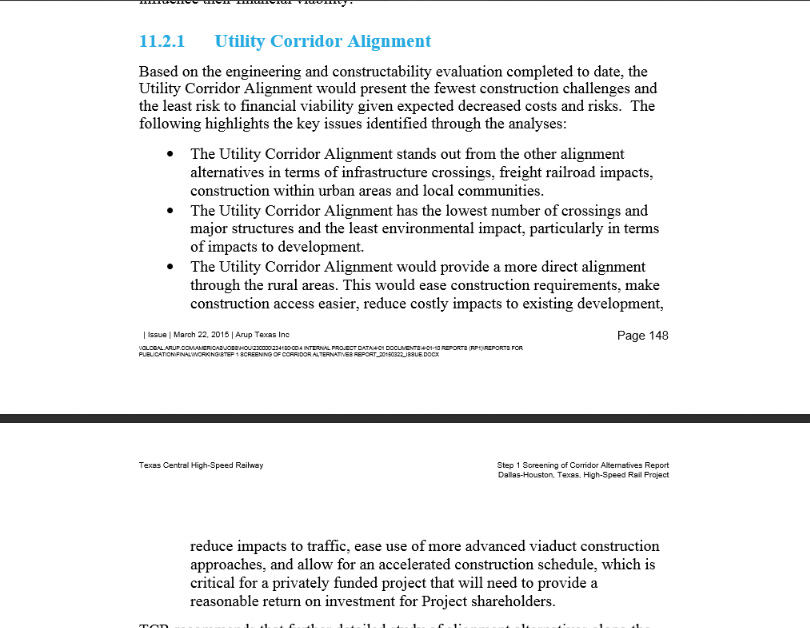
The Step 1 Screening of Corridor Alternatives Report is peppered with references to crossings of railroads, pipeline, roads and utility lines, yet no mention of crossings on private property. The true priorities are found on page 148.

  • “…the Utility Corridor Alignment would present the fewest construction challenges and the least risk of financial viability given expected decreased costs and risks.”
    • “The Utility Corridor Alignment stands out from the other alignment alternatives in terms of infrastructure crossings..”
    • “The Utility Corridor Alignment has the lowest number of crossings…”
    • “The Utility Corridor alignment would provide a more direct alignment through rural areas. This would ease construction requirements, make construction access easier, reduce costly impacts to existing development, reduce impacts to traffic, ease use of more advanced viaduct construction approaches, and allow for an accelerated construction schedule, which is critical for a privately funded project that will need to provide a reasonable return on investment for Project shareholders.”

Click to enlarge. Will open in a new window. Check your pop-up settings.

Click to enlarge. Will open in a new window. Check your pop-up settings.

The reality is that the free movement of people, livestock and wildlife is not a priority to the developers of this business venture backed by Japanese investors. Financial considerations are the bottom line and additional crossings equal increased costs.

Texas Central is not recreating the wheel. They are hoping to deploy technology already being utilized in Japan. Presumably, they know the specs and estimates of how much each crossing would cost to construct, as well as how many they could construct while still being financially feasible. But even while maintainting that they are committed to working with landowners, they have yet to provide any details on how much and how often they will provide access to landowners. The only real priority we have seen regarding landowners is when Texas Central made it a top priority to be in Austin to oppose any legislation supported by landowners, who were really making it a priority to protect their land and livelihoods. It was very clear that investor confidence was their only priority and not “working with landowners.”

So…Texas Central…landowners want to know exactly how often and how much access they will be granted after their land is taken. But, at this point, various access scenarios would at least make it seem like landowner access is even somewhere on the list.

The volunteers at TAHSR are working to make sure private property owners have unobstructed access to their properties by stopping this project.  Please help us by joining TAHSR today.

FRA releases report that still does not eliminate proposed routes

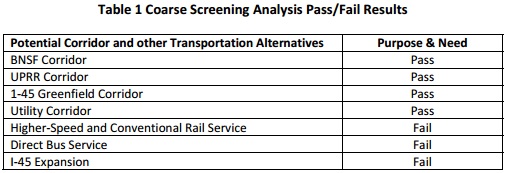
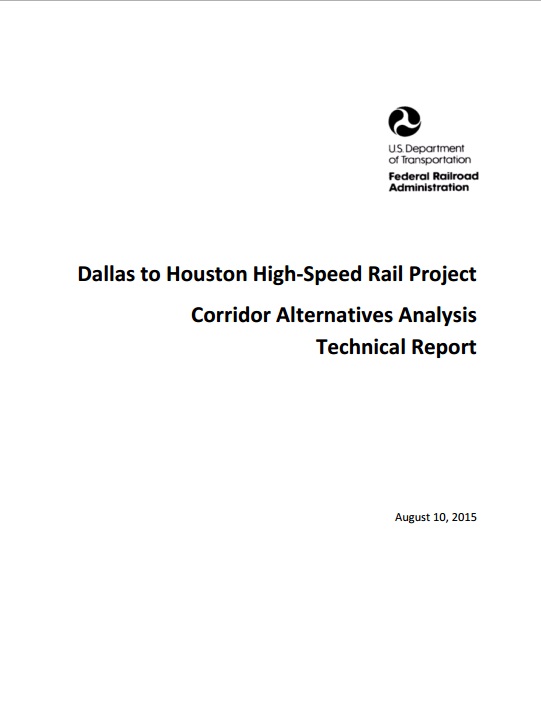
Last week the Federal Railroad Administration (FRA) released it’s Corridor Alternatives Analysis Technical Report. Although the FRA expressed it’s further investigation efforts will be directed at the Utility Corridor, the FRA will retain the other proposed routes (BNSF, UPRR and I-45) for further review should something arise along the Utility Corridor and portions of those other corridors are needed.

FRA Report Table

On page 15 of the report, the FRA states,

FRA determined that the Utility Corridor should be retained for further investigation. It has the potential to meet TCR’s purpose and technical requirements for high‐speed passenger rail service between the Dallas and Houston metropolitan regions. There are no physical characteristics, operational feasibility, or environmental constraints at this first planning stage that would result in FRA eliminating the Utility Corridor from further consideration. Therefore, FRA carries the Utility Corridor forward into the alignments screening analysis. FRA’s next step will be to identify and screen potential location alternatives within corridors and potential station area alternatives. FRA also determined that the BNSF, UPRR, and I‐45 Greenfield Corridors should be retained for further investigation for portions of these corridors in the event that constraints arise along the Utility Corridor that warrant potential location alternatives within portions of these eliminated corridors that avoid the constraints.

Based on the evaluation documented in this report, a second screening analysis will be conducted. The second screening analysis will provide a more detailed evaluation of the range of potential location alignments near and within the Utility Corridor recommended in this Corridor Alternatives Analysis. Combined with station area locations, the alignments screening analysis will evaluate the location alignments within this corridor to identify the Build Alternatives that will be the subject of the evaluation in the EIS.

To view or download the full report, click the image below:

Adding It Up

It looks like Texas Central Partners and Federal Railroad Administration have some explaining to do. Look closely at the FRA reports…same agency, same year, two different projects, same city, two very different population projections. The largest number is being used to show potential ridership in order to attract investors for TCP’s Dallas Houston HSR. And their numbers suggest the population of both metro areas will double by 2035.

Who is making up these numbers? Which report should investors, the public and elected officials believe?